

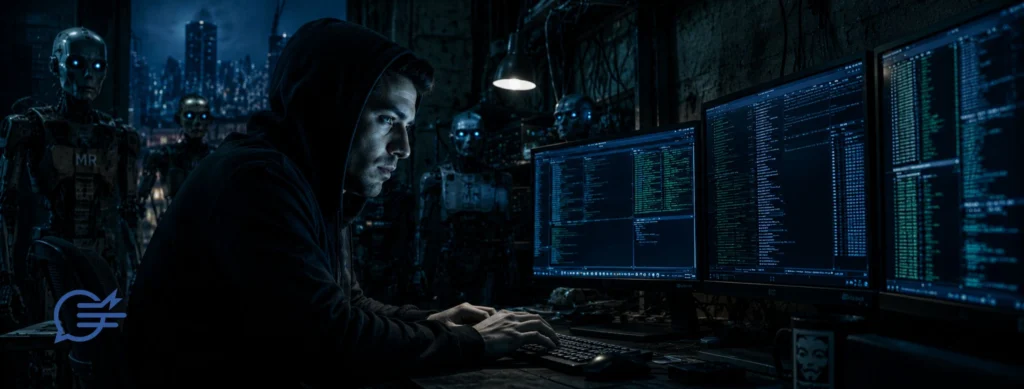
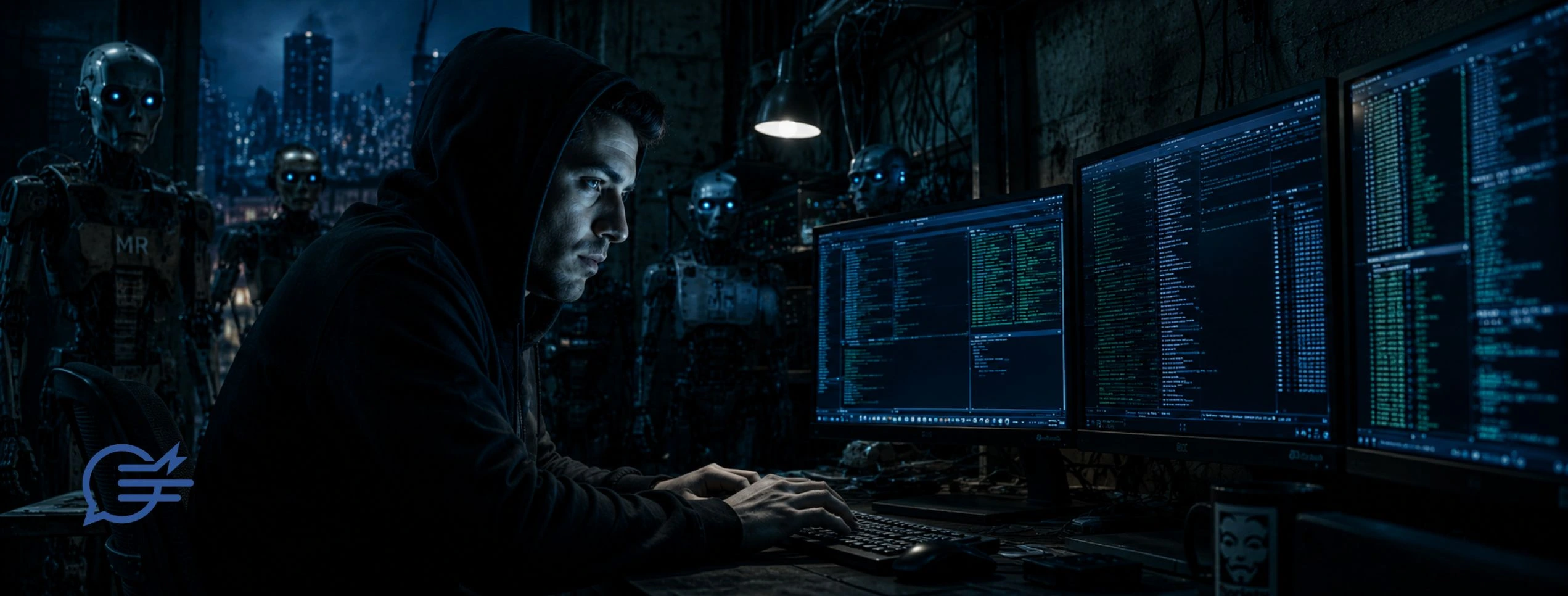
Type “Ponas Robotas” into a search engine today and you’ll get something more layered than a simple translation result. You’ll find Lithuanian-language reviews of a critically acclaimed television series, tech blog articles discussing intelligent robotic systems, and cultural commentary on what it means to give a machine a polite human title.
The phrase itself is straightforward enough: in Lithuanian, ponas means “Mister” or “Sir,” and robotas means “robot.” Together they yield “Mr. Robot” — the localized Lithuanian title of Sam Esmail’s acclaimed USA Network psychological thriller that aired from 2015 to 2019. But the phrase has accumulated meanings beyond a TV translation. In certain tech circles across Eastern Europe and beyond, “Ponas Robotas” is now used as a kind of shorthand for any sufficiently intelligent, human-interacting robotic system — one that responds to context rather than simply following a fixed script.
This guide covers all of it: where the phrase comes from, what made the series so enduring, why a television drama about a hacker still resonates years after its finale, and how a Lithuanian translation ended up as a minor cultural touchstone in 2026 technology discourse.
What Does Ponas Robotas Mean?
The phrase is a direct, grammatically natural Lithuanian translation of “Mr. Robot.” Ponas is the standard polite form of address for a man in Lithuanian — equivalent to the English “Mister” or the French “Monsieur.” Robotas is the Lithuanian word for robot, borrowed from the same Czech source (robota, meaning forced labor or drudgery) that gave the word “robot” to most European languages in the early 20th century, following Karel Čapek’s 1920 play R.U.R.
What’s interesting about the construction is what it implies culturally. Lithuanian, like many Baltic languages, tends to personify technology in natural ways. Adding the honorific ponas to robotas doesn’t sound odd in Lithuanian — it sounds almost courteous, as though you’re addressing the machine as a colleague rather than describing a tool. This linguistic quality is one reason the phrase has taken on a second life in tech discussions: it captures something real about how people’s relationships with sophisticated automated systems have shifted over the past decade.
For most Lithuanian-speaking audiences, though, the primary association remains the television series. When a Lithuanian viewer searches for Ponas Robotas on a streaming platform or film database, they’re looking for the same four-season psychological thriller that English-speaking audiences know as Mr. Robot. The localized title helped the series find its Baltic audience and contributed to genuine fandoms in Lithuania, Latvia, and Estonia during the show’s original run and in the years since.
The Series: Mr. Robot on USA Network (2015–2019)
Mr. Robot premiered on the USA Network on June 24, 2015, to an audience that largely had no idea what to make of it. USA Network at the time was best known for lighter procedural fare. A dense, psychologically disorienting drama about a mentally ill hacker plotting to erase global debt records was not what the network’s regular viewers were expecting.
The series follows Elliot Alderson, played by Rami Malek, a cybersecurity engineer who works at a firm called Allsafe by day and operates as a vigilante hacker at night — using his skills to expose people he considers predatory or corrupt. Elliot struggles throughout the series with dissociative identity disorder, social anxiety, clinical depression, and drug abuse. He is recruited by a mysterious anarchist figure known only as Mr. Robot, played by Christian Slater, to join a hacktivist group called fsociety. Their goal is ambitious to the point of chaos: encrypt and destroy the financial records of E Corp, the world’s largest conglomerate, wiping out consumer debt in the process.
The pilot had been made available online and via video-on-demand services before its official linear broadcast, which created unusual early word-of-mouth. By the time the show aired on cable, it already had the beginnings of an enthusiastic following. Critics noticed it immediately. The series ran for four complete seasons across 45 episodes before concluding in December 2019.
“
“I always thought, ‘Look, we’re not going to go mainstream or break through, especially in this age of Peak TV. But hopefully we’ll have enough of a following to justify our existence.'”
— Sam Esmail, Creator of Mr. Robot, speaking before the show’s critical breakthrough
Sam Esmail: The Vision Behind Ponas Robotas
Sam Esmail was born in 1977 in Hoboken, New Jersey, to Egyptian immigrant parents. He has spoken openly about the tension of growing up as a second-generation American — the alienation, the distance from mainstream culture, the sense of being a perpetual outside observer. That perspective infuses almost every project he has made, but nowhere more completely than in Mr. Robot.
Esmail has described Elliot Alderson as “a thinly-veiled version” of himself. He had originally intended the story to be a feature film and spent roughly fifteen years thinking about a hacker-culture narrative before the material expanded into something that felt better suited to the serial format. He cited the 2011 Arab Spring, and particularly the Egyptian Revolution in which young people used social media to challenge political power, as a significant influence on the show’s themes.
His approach to directing was uncommonly hands-on. After directing three episodes of the first season, Esmail took sole directorial control for the entirety of seasons two through four — directing all remaining episodes himself, a total of 38 of the show’s 45 episodes. This level of creative control is essentially unheard-of in American cable television and gave the series a visual and tonal consistency that critics noticed immediately. Esmail’s framing style — placing characters in corners, using asymmetric compositions that create a constant low-grade unease — became one of the most discussed aspects of the show’s visual language.
He also consulted cybersecurity professionals throughout production to ensure the hacking scenes were technically credible. While dramatic television rarely achieves full accuracy on technical subjects, Mr. Robot came close enough that security researchers frequently cited it as one of the few realistic portrayals of their field in popular media.
Themes, Characters & Cultural Impact
The show operates on several levels simultaneously. On the surface it’s a techno-thriller about hacktivism and corporate power. But its real subject is identity — who we are, how much of our behavior we actually control, and how the systems around us (financial, technological, social) shape what we believe to be our autonomous choices.
Mental Health Representation
One of the show’s most widely noted qualities was its portrayal of mental illness. Elliot’s dissociative identity disorder, social anxiety, and depression are not treated as quirks or plot devices — they are the lens through which the entire story is told. Psychiatrists and mental health researchers praised the series at the time of broadcast for what several described as one of the most accurate on-screen depictions of dissociative identity disorder and chronic depression ever committed to film or television. Rami Malek’s performance was central to this: critics and medical professionals alike noted the specificity and restraint with which he embodied Elliot’s condition, avoiding both the romanticization and the demonization that tend to distort similar portrayals.
Digital Privacy & Corporate Power
The show’s central antagonist is not a person — it’s a corporation. E Corp (which Elliot’s narration consistently calls “Evil Corp”) functions as a stand-in for the kind of systemically embedded financial power that ordinary people can see affecting their lives but can’t easily challenge. The series asked its audience to think seriously about who controls data, how debt functions as a mechanism of social control, and whether digital infrastructure can be used as a tool of liberation or merely redistributes the same power to different hands.
These questions felt somewhat speculative in 2015. A decade later, following a series of major data breaches, escalating debates over surveillance capitalism, and the accelerating consolidation of power in large technology companies, the series now reads less as speculative fiction and more as a fairly accurate account of tensions that are still playing out.
The Character of Mr. Robot
Christian Slater’s Mr. Robot is perhaps the most symbolically loaded character in the series. He represents urgency, rebellion, and decisive action — the part of Elliot that wants to burn the system down rather than navigate it. His relationship to Elliot is the show’s central mystery for much of the first season and the foundation of most of its later psychological complexity. Slater won a Golden Globe for the role, which represented something of a career high point and earned considerable critical reevaluation of his earlier work.
Ponas Robotas in Technology Culture
The phrase’s second life in technology discussions began organically, primarily in Eastern European tech publishing around 2024. Writers covering intelligent robotic systems — collaborative factory arms, household automation devices, humanoid prototypes — started using “ponas robotas” as a descriptive shorthand for a specific kind of machine: one that doesn’t simply follow preprogrammed instructions but interacts with its environment in adaptive, contextually aware ways.
The appeal of the phrase in this context is partly linguistic and partly cultural. Attaching a polite human title to a robot carries a quiet implication — that the machine in question is sophisticated enough to merit address, to be spoken to rather than simply operated. As AI-powered robots have become more conversational and responsive, there’s a natural human tendency to personify them, and “Ponas Robotas” captures that tendency with elegant economy.
It’s worth being clear about what this usage is and isn’t: no commercial product bears the name “Ponas Robotas,” and no organization has formally adopted the phrase as a technical term. It circulates in tech blogs, forum discussions, and informal industry commentary as a piece of cultural vocabulary — useful precisely because it carries both a cultural reference point (the series) and a descriptive value (a robot with human-adjacent attributes) in two short words.
The Word “Robot” and Its Origins
Any discussion of Ponas Robotas benefits from a brief reminder of where the word “robot” itself came from. Czech playwright Karel Čapek introduced the term in his 1920 play R.U.R. (Rossum’s Universal Robots), drawing on the Czech word robota — meaning drudgery or forced labor — to describe artificial workers. The play was the first major Western dramatic treatment of the idea that manufactured beings might someday rebel against their human creators. It was translated into Lithuanian and dozens of other languages within years of its premiere, and robotas entered Lithuanian vocabulary as a natural adaptation of the Czech original.
Over the century since, “robot” has migrated from science fiction to factory floors to domestic spaces. The machines to which the term now applies range from simple automated vacuum cleaners to surgical precision tools to collaborative arms working alongside assembly workers. The word itself no longer implies rebellion or existential threat — though the television series bearing its Lithuanian translation made a point of exploring whether that earlier anxiety might still be warranted, albeit in revised form.
“The phrase captures something real: the moment when a machine becomes sophisticated enough that you stop thinking of it as a device and start treating it as a presence.”
— Editorial Observation
Legacy & Continued Relevance in 2026
Mr. Robot concluded in December 2019 and has since moved off most major streaming platforms, which has created a somewhat paradoxical situation: a show that is widely considered one of the better American television series of the 2010s is not easily streamable. This has, if anything, increased its cult status. Fans in Lithuanian-speaking regions who discovered it as Ponas Robotas on local platforms during its original run continue to revisit and discuss it in online communities.
In April 2026, the series resurfaced on video-on-demand charts, suggesting ongoing organic interest beyond its formal streaming availability. Rami Malek, when asked in 2025 about the possibility of a revival, indicated he and Esmail remain close but offered no concrete plans. Christian Slater was performing on Broadway at the time of those remarks. The core creative team, by most accounts, regards the show as complete.
The subreddit r/MrRobot has grown to over 200,000 members. Annual community rewatches continue to attract thousands of participants. Fan theory discussions, original artwork, and critical reappraisals appear regularly across platforms. The r/MrRobot community has also produced several detailed comparisons between the show’s fictional technopolitical scenarios and real-world developments since 2019 — a genre of fan engagement that the show’s design actively encouraged.
The show’s localization success in Lithuania is a smaller but not insignificant part of this story. Streaming-era content distribution studies have pointed to Ponas Robotas as a minor case study in how a well-chosen localized title — one that reads naturally in the target language and carries genuine meaning rather than sounding like a transliteration — can help build regional fan communities. Lithuanian, Polish, and Estonian streaming platforms all reported strong viewership numbers for the series during its original run, with Baltic fan communities becoming among the show’s most engaged international audiences.
There’s also a broader point here about how television fiction and technology discourse interact. Mr. Robot / Ponas Robotas was one of the first major prestige television productions to treat hacking, digital surveillance, and corporate data control as serious dramatic subjects rather than background texture. The show consulted real cybersecurity professionals, depicted actual tools and techniques, and built narratives around threat models that practitioners recognized as realistic. This contributed to genuine public interest in topics like data privacy, end-to-end encryption, and the ethics of corporate data collection — topics that have only grown more salient in the years since.