

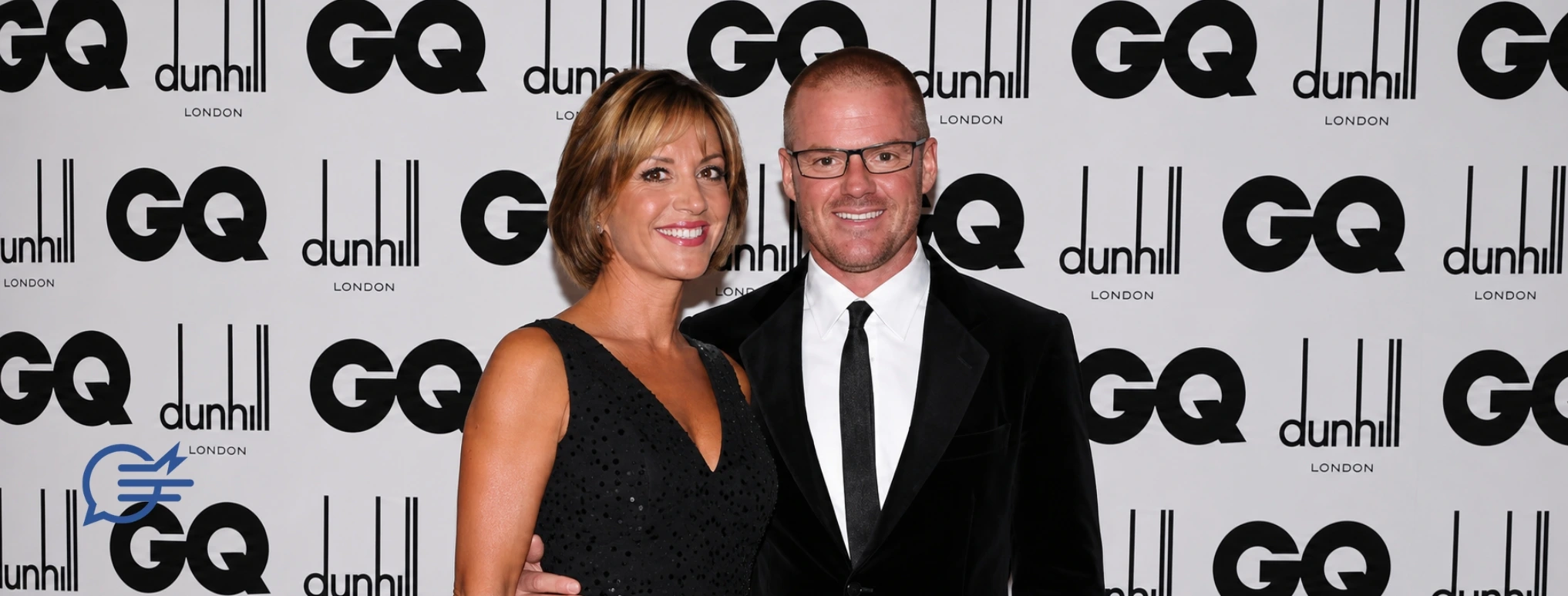
Behind every great empire, there is often an unseen architect. In the story of The Fat Duck — the three-Michelin-star restaurant in Bray, Berkshire, that was once crowned the best restaurant in the world — that architect was not only Heston Blumenthal, the eccentric genius in the kitchen. It was also Zanna Blumenthal, his childhood sweetheart, his wife of 28 years, and the woman he publicly credited as the single biggest reason for his extraordinary success.
Zanna Blumenthal — whose full given name is Susanna Blumenthal — is a private British woman who came to the world’s attention almost exclusively through her long marriage to Heston Blumenthal, one of the most innovative and celebrated celebrity chefs of the 21st century. While she has never sought the spotlight for herself, her story is one of genuine sacrifice, steadfast loyalty, and quiet resilience. She gave up her own professional career as a nurse, raised three children largely on her own while her husband revolutionised global gastronomy, and navigated a 28-year marriage that ultimately ended — amicably — in one of the most dignified divorces in British celebrity history.
This biography takes a deep, thorough, and fully fact-checked look at who Zanna Blumenthal really is: her background, her years beside one of Britain’s greatest chefs, her role as a mother, and the private life she has quietly carved out for herself in the years since her separation in 2011 and the formal granting of her divorce in 2017.
Early Life & Background
Zanna Blumenthal, whose full given name is Susanna, was born in England in the mid-1960s — most reports place her age at approximately 52 years old at the time of her 2017 divorce, pointing to a birth year of around 1964 or 1965. Like her future husband Heston, very little about her childhood, family background, or early schooling has ever been made available to the public. She has always been an intensely private person, and that discretion has defined her public presence — or rather, the deliberate absence of it — throughout her adult life.
What is publicly known and confirmed across multiple credible sources, including The Guardian’s coverage of Heston Blumenthal and court documents reported by The Telegraph and Hello! Magazine, is that Zanna trained and worked as a nurse during the early years of her relationship with Heston. This is a critically important detail. It tells us that Zanna was not simply a passive partner drifting alongside a famous man’s career — she was a trained healthcare professional with her own skills, her own identity, and her own working life before she made the profound decision to set that career aside to support her husband’s extraordinary culinary ambitions.
She and Heston met as teenagers — a fact that both have confirmed — in a time long before The Fat Duck, before the Michelin stars, before the television programmes and the global fame. At that point, Heston was working as a credit controller, a far cry from the world-renowned molecular gastronomist he would become. Their early relationship was that of two ordinary young British people finding their way in the world, with no particular indication of the extraordinary trajectory that lay ahead for the family they would eventually build together.
Marriage to Heston Blumenthal & The Fat Duck Years
Zanna and Heston Blumenthal were married in 1989, a union that would last — through all its trials, sacrifices, and eventual strains — for 28 years. Their three children, Jack, Jessie, and Joy, were born during this period, growing up in the Buckinghamshire countryside not far from The Fat Duck in Bray, which would come to define their family’s entire existence.
The Fat Duck was purchased by Heston in 1995 — a run-down pub in Bray, Berkshire, that he transformed from scratch into one of the greatest culinary establishments the world has ever seen. In those early, precarious years, the restaurant came extraordinarily close to bankruptcy on multiple occasions. Heston has spoken publicly about selling his house, his car, and many of his personal possessions simply to keep the doors open. Throughout all of this uncertainty and financial turmoil, Zanna was his anchor — at home, raising their children and managing the domestic realities of family life while her husband poured every waking hour into the kitchen.
“
“Zanna is the biggest reason for the success of the restaurant. She has been the one doing the sacrificing in order to support what I wanted to do.”
— Heston Blumenthal, publicly acknowledging Zanna’s pivotal contribution
That extraordinary tribute from Heston himself — one of the most candid and heartfelt acknowledgements ever made by a celebrity chef about a spouse — captures the essential truth of Zanna’s role during those years. The Fat Duck’s rise from a struggling bistro to a three-Michelin-star institution named the world’s best restaurant in 2005 by the World’s 50 Best Restaurants was built, in no small part, on the foundation of stability and selflessness that Zanna provided at home.
Heston also appeared in several of his early BBC television series during the mid-2000s, including Heston Blumenthal: In Search of Perfection, in which Zanna briefly appeared — one of the rare occasions when the general public caught a glimpse of the woman behind the chef. Her appearances on IMDb confirm this: she is listed for her appearances on In Search of Perfection and Big Chef Takes on Little Chef, the Channel 4 series in which Heston attempted to revitalise the Little Chef roadside café chain. These cameos were not of a woman seeking fame — they were of a devoted partner quietly stepping into frame beside a man the world was beginning to celebrate.
Zanna’s Unsung Role in Building a Culinary Empire
To truly understand Zanna Blumenthal’s story, one must understand the sheer scale of what she sacrificed — and what she enabled. The Fat Duck is not simply a successful restaurant. It is a landmark of culinary history. It is the place that introduced concepts like snail porridge, bacon-and-egg ice cream, and the famous “Sound of the Sea” dish — an edible installation served with an iPod playing coastal soundscapes — to a stunned global audience. It earned three Michelin stars, placed first in the World’s 50 Best Restaurants in 2005, and single-handedly elevated the conversation around food, science, and sensory experience.
None of that happened in a vacuum. Behind the liquid nitrogen and the centrifuges and the late nights in the Bray kitchen was a family waiting at home. And for the most formative years of that family’s life, it was Zanna who held it all together. She gave up a professional career in nursing — a demanding, skilled vocation in its own right — to become what she herself described in an interview with Woman & Home magazine as functioning “pretty much as a single parent.” That is not hyperbole. Heston has publicly acknowledged spending vast stretches of time away from his family, including one haunting memory he shared publicly: on crutches following back surgery over Christmas, he was helping his son Jack put up decorations when Jack mentioned it was the first time they had ever done that together. Jack was 13 or 14 years old at the time. Heston described carrying that regret for a long time afterward.
For Zanna, this was not an occasional absence — it was the sustained reality of two decades of marriage. She managed the school runs, the childhood milestones, the day-to-day emotional and logistical architecture of family life in Buckinghamshire, while her husband built a global brand. Her contribution to The Fat Duck’s success was, as Heston freely admitted, incalculable — and under British family law, that contribution was legally and rightfully recognised when the time came for the couple to divide their assets.
Separation, Divorce & Settlement
Heston and Zanna Blumenthal separated in August 2011. The reasons for the breakdown of their marriage were never fully aired publicly. Court documents cited by the press simply noted that the marriage had “irretrievably broken down” — with the legal grounds being two years’ separation with consent. Zanna is believed to have referenced irreconcilable differences. What is significant is how both parties chose to handle the end of their marriage: with extraordinary dignity, mutual respect, and a firm commitment to protecting their three children.
Rather than rushing to the courts and fighting publicly over assets, Heston and Zanna spent six full years quietly negotiating their financial settlement outside of any courtroom. It was only once both parties were fully satisfied with the arrangement they had reached — on their own terms, without judicial intervention — that Zanna formally filed for divorce. The proceedings themselves, when they finally came, lasted just 90 seconds. On 26 April 2017, District Judge Anne Hudd of the Central Family Court granted Zanna the decree nisi. Neither Heston nor Zanna was present at the hearing. The judge confirmed the couple was “entitled to a decree of divorce” and noted that all financial claims had been settled in full.
Legal analysts and family law commentators in the UK pointed to the Blumenthal divorce as a model example of how high-net-worth separations can be handled without acrimony. Firms such as Vardags Family Law wrote approvingly of the couple’s approach, noting that under English and Welsh law, homemaker contributions are treated as equal to financial contributions — meaning Zanna’s two decades of childcare and domestic management entitled her to a full and equal share of the marital estate.
Children: Jack, Jessie & Joy Blumenthal
Zanna and Heston Blumenthal are parents to three children: Jack, Jessie, and Joy Blumenthal, all born in England. At the time of the April 2017 divorce hearing, Jack was approximately 24 years old, Jessie was around 21, and Joy was approximately 19 — all of them by then young adults. Joy Blumenthal is recorded as having been born in 1997.
All three children grew up in Buckinghamshire, largely under their mother’s supervision given the demands of their father’s professional life. Heston has spoken with considerable emotion in interviews about the distance his career created between himself and his children, acknowledging that Zanna bore the lion’s share of parenting responsibility throughout their marriage. That his son Jack’s appearance in Heston’s deeply personal 2025 BBC documentary Heston: My Life With Bipolar — in which the two had a raw, emotionally charged conversation about the pain caused by years of Heston’s absence and unpredictable behaviour — is a testament to the family bonds that Zanna worked hard to maintain even through the most turbulent periods.
Despite their high-profile parentage, all three Blumenthal children have maintained a notably private existence. None of them have sought public profiles commensurate with their father’s fame, which likely reflects the values instilled in them by their mother — a woman who has consistently prized privacy, discretion, and normalcy over celebrity. Following the separation, both Heston and Zanna confirmed they had remained on good terms for the sake of their children, and by all available accounts, that co-parenting arrangement has continued to function with warmth and mutual regard.
“Despite the intense public scrutiny of their marriage and divorce, Zanna Blumenthal has raised three grounded, private young adults — a quiet but profound achievement in its own right.”
— GossipWire Editorial Desk
Net Worth, Income & Financial Settlement
Zanna Blumenthal’s personal net worth has never been publicly disclosed, and any specific figure circulating online should be treated with scepticism, as none are drawn from verified or documented sources. What can be said with confidence is the following: under English and Welsh family law, a spouse who has made substantial non-financial contributions — including homemaking, childcare, and enabling the other spouse’s career — is fully entitled to an equal share of the marital estate upon divorce. Zanna’s 28-year marriage, her sacrifice of a nursing career, and her role as the primary parent to three children would, by any reasonable legal standard, qualify her for exactly that.
Heston Blumenthal’s net worth, for context, is estimated by sources including Celebrity Net Worth at approximately $5 million, while other outlets such as Prime Journal have estimated the figure as high as $25–30 million when accounting for his restaurant group, television royalties, book sales, brand partnerships, and the Fat Duck Group’s overall commercial value. The marital home in Marlow — purchased jointly for £2.4 million in 2012 and listed for £3.25 million in 2017 — was among the known tangible assets in the estate.
Because Heston and Zanna resolved their financial proceedings entirely outside the courts, the specific details of their settlement — how assets were divided, what ongoing financial provisions were agreed, and the total sum involved — remain entirely private. Both parties signed a full and final settlement, and both have honoured that agreement without public dispute. Zanna currently resides in Marlow, Buckinghamshire, confirming that she retained a significant and comfortable lifestyle following the conclusion of proceedings.
Life After Heston: Marlow & Moving Forward
Following their August 2011 separation, Heston relocated to Barnes in south-west London, while Zanna remained in Marlow, Buckinghamshire — the picturesque Thames-side market town in which the family had built much of their shared life. That she chose to remain in Marlow, close to the social fabric of the area and the home she had helped to create, speaks to a woman who was not running from her past but rather continuing to live it on her own terms.
Since 2011, Zanna Blumenthal has maintained an exceptionally low public profile. There are no verified social media accounts, no public statements, no interviews, and no media appearances on record for her in the years following the separation. She has not sought to monetise her celebrity-adjacent status, nor has she attempted to capitalise on her connection to one of Britain’s most recognisable chefs. This is, in many ways, the most defining aspect of her character: a consistent, principled commitment to privacy and personal dignity that has never wavered regardless of circumstance.
Meanwhile, Heston’s life has continued at a dramatically different pace. He was briefly in a five-year relationship with American food writer and actress Suzanne Pirret (2011–2015), before becoming romantically involved with French estate agent Stephanie Gouveia. He had a daughter with Gouveia in late 2017, but that relationship had also ended by 2023. In March 2023, Heston married French entrepreneur Melanie Ceysson in a private ceremony, and as of 2025 the couple were living in a village in Provence. In November 2023, Heston was sectioned in France following a serious manic episode, and was subsequently diagnosed with bipolar disorder — a revelation that reframed much of his behaviour during the marriage years and which he addressed publicly in the 2025 BBC documentary.
None of the turbulence of Heston’s post-marriage life appears to have involved or implicated Zanna in any public way. She has remained entirely outside the orbit of his subsequent relationships, professional upheavals, and health disclosures — a boundary that both parties have seemingly respected absolutely. By all available accounts, she continues to live quietly and comfortably in Marlow, connected to her three grown children and to the community she has called home for many years.
What Zanna Blumenthal’s story ultimately illustrates is something that goes far beyond celebrity gossip or divorce proceedings. It is a portrait of a woman whose contribution to one of the great success stories in British culinary history was fundamental, whose sacrifice was genuine and immeasurable, and whose subsequent life — lived entirely on her own quiet terms — deserves to be understood with nuance, accuracy, and respect. She is not a footnote in Heston Blumenthal’s biography. She is, by his own admission, one of the primary reasons it exists at all.