

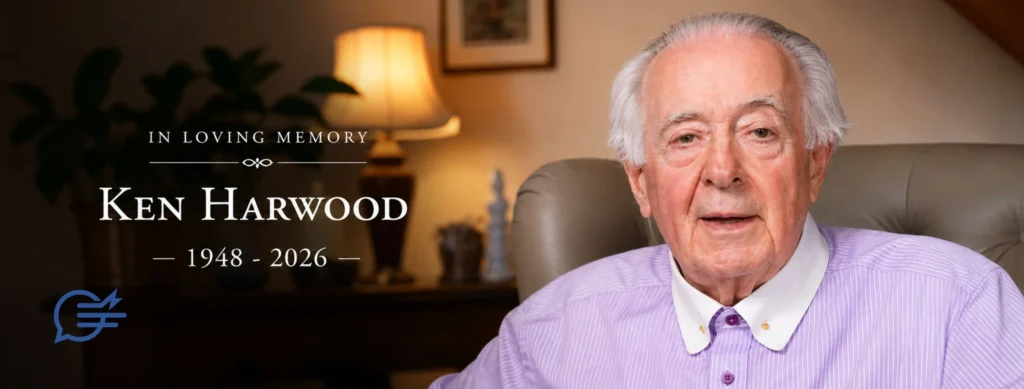
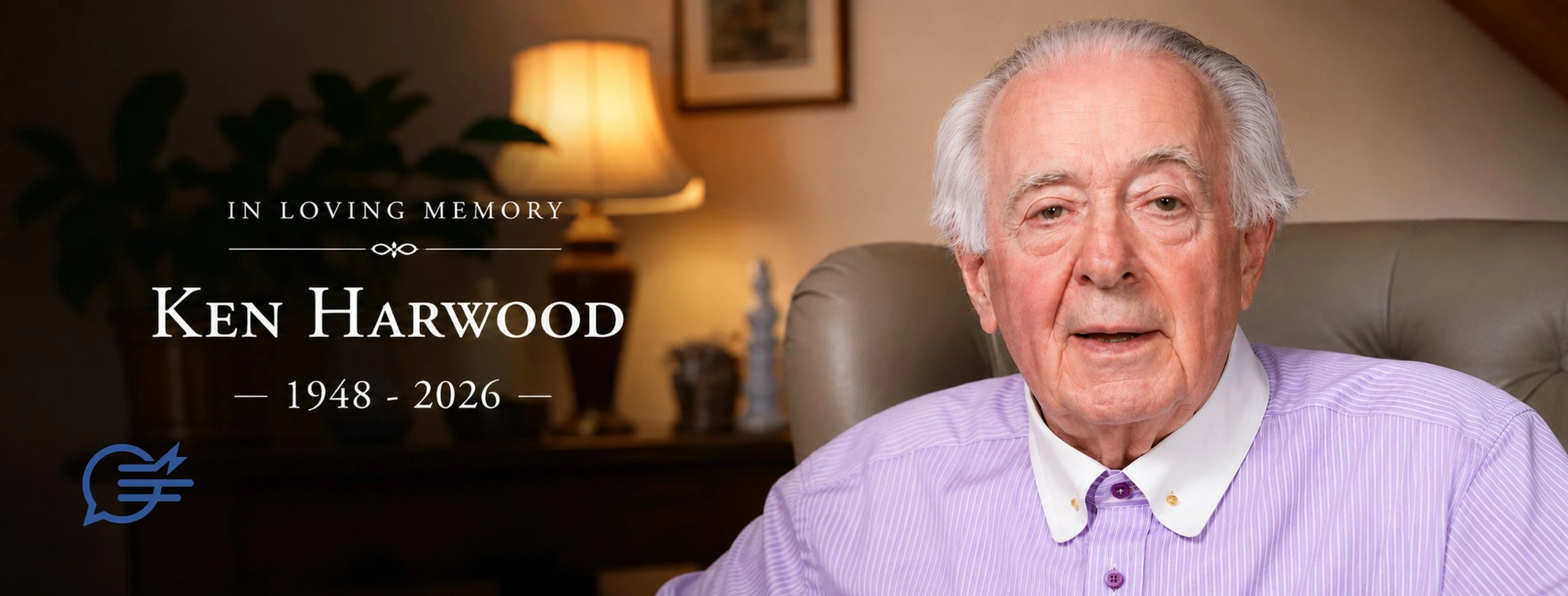
In a television landscape often dominated by manufactured drama and fleeting celebrity, Ken Harwood was something altogether rarer — a genuinely ordinary man whose extraordinary decency, dry wit, and unshakeable love for his wife Anne made him one of the most cherished faces ever to appear on Channel 4’s Gogglebox. His passing in May 2026 at the age of 77, following a short illness, prompted an outpouring of grief from fans across the United Kingdom that spoke volumes about the quiet but profound impact he had on everyone who watched him.
Ken Harwood was not a showbiz veteran chasing a second act. He was a former postmaster who had spent three decades serving his community in County Durham, then a local councillor, and eventually a retiree who — alongside his devoted wife of 55 years — agreed to open his living room to the cameras of one of Britain’s most beloved reality programmes. What followed was television gold: two series regulars who never once felt like performers, because they simply weren’t. They were themselves, and the nation loved them for it.
This in-depth biography traces Ken Harwood’s life from his roots in Consett, County Durham, through his long professional career in the Royal Mail postal service, his years of civic engagement as a local councillor, and finally his warm, memorable tenure on Gogglebox between 2020 and 2022. It also examines the family he leaves behind — wife Anne, sons Simon and Ross, daughter-in-law Elle, and grandchildren Freya and Tristram — and reflects on why his legacy will endure long after the final credits roll.
Early Life & Background in Consett, County Durham
Ken Harwood was born in 1948 in Consett, a market town in County Durham in the north-east of England. Consett, at the time of Ken’s birth and childhood, was a proud industrial town defined by its enormous steelworks — the Consett Iron Company and later the British Steel Corporation plant that dominated employment in the area for generations. Growing up in post-war north-east England meant Ken came of age in a community shaped by hard graft, tight-knit neighbourhoods, and an unassuming, no-nonsense outlook on life. Those values — community, reliability, honest work, and straightforwardness — would define every chapter of his life that followed.
While specific details about his schooling and family of origin remain private — Ken was never a man who sought the spotlight for its own sake — what is known is that he came from the working-class tradition that was the backbone of County Durham during the mid-twentieth century. The region’s culture placed enormous value on public service and community contribution, and it is no coincidence that Ken would go on to spend his working life serving the public in two distinct but equally important capacities: as a postmaster and as a local councillor. Both careers spoke directly to the world he grew up in — a world where showing up for your neighbours was not a political act but simply what decent people did.
Consett experienced significant upheaval in 1980 when the steelworks — which had employed thousands — closed, devastating the local economy. Ken, by then already established in his postal career and building a family with Anne, was part of a generation that witnessed that painful transition first-hand. The experience of watching a community rebuild itself from economic shock gave him a perspective on everyday life that was grounded, empathetic, and never given to excess or pretension. These qualities would later become endearing hallmarks of his Gogglebox appearances, where his measured, down-to-earth commentary on television programmes resonated with viewers who were tired of celebrity loudmouths and craved authentic, considered voices instead.
Career as Postmaster & Local Councillor — Three Decades of Public Service
Ken Harwood’s professional life was defined by service. He worked as a postmaster for 30 years — a career that placed him at the heart of his local community in County Durham. The role of postmaster in a small English town is one that extends far beyond the simple transaction of stamps and parcels. A postmaster is a trusted figure: someone who processes pension payments, handles sensitive financial transactions, accepts bill payments, and often acts as an informal point of contact for elderly or isolated residents who may have few other reasons to leave their homes. Ken took these responsibilities seriously and was widely regarded as a reliable, familiar, and respected presence in his corner of the north-east.
His three decades of postal service placed him in the same professional tradition as tens of thousands of unsung community figures across the United Kingdom — people whose contributions to local life are immense but rarely celebrated in the national press. Post offices, particularly in towns like those of County Durham, have served as social hubs, lifelines for the elderly, and anchors of civic identity. Ken’s commitment to that role over such a sustained period speaks to a character defined by steadiness, loyalty, and a genuine sense of vocation rather than mere employment.
After his postmaster career wound down, Ken extended his public service further by becoming a local councillor. Local government in England — particularly at the district and parish level — is the democratic layer closest to ordinary citizens, dealing with planning decisions, local amenities, road maintenance, and community services. Councillors are unpaid volunteers in many cases, giving their time and expertise to ensure their neighbourhoods are properly represented and their residents’ concerns are heard. Ken’s decision to stand as a councillor after his postal career demonstrated that his commitment to public life was not circumstantial but deeply held. He understood that civic society depends on individuals willing to step forward, take responsibility, and do the quiet, unglamorous work of governance.
Ken Harwood retired in 2013, concluding a professional life that had spanned the better part of five decades. By the time he sat down in front of the Gogglebox cameras seven years later, he brought with him not just a warm personality but a lifetime’s worth of perspective on British society — its quirks, its values, its humour, and its occasional absurdities. That perspective made him a natural fit for a show that asked its participants to simply watch television and react honestly.
“
“You have put me to shame now with a card and roses, and I got you nothing.”
— Anne Harwood, responding to Ken’s surprise bouquet of 50 roses on their debut Gogglebox appearance
Gogglebox: Series 15 to 19 and the Making of a Fan Favourite
Gogglebox on Channel 4 is one of the most consistently popular shows in British television history. Since its debut in 2013, it has introduced audiences to dozens of households across the United Kingdom whose sole television function is to watch and react to the week’s most notable programming — from breaking news coverage to reality show spectacles, sporting events, and drama series. Crucially, the show’s magic lies not in the programmes being watched, but in the watchers themselves: the unscripted, unfiltered commentary of real people sitting in their own living rooms, reacting with genuine spontaneity.
Ken and Anne Harwood joined the Gogglebox cast for Series 15, which aired in 2020, and remained fixtures of the show through to Series 19 in 2022 — a five-series run that placed them firmly among the programme’s most recognisable and beloved participants. The north-east England couple, filmed in their home in County Durham, quickly differentiated themselves from other households through the quiet, easy dynamic of a couple who had spent over five decades together and had no need to perform for anyone. Their chemistry was not manufactured for television; it was the product of a lifetime spent in each other’s company, and it radiated through the screen with an authenticity that viewers found deeply refreshing.
Ken’s on-screen persona was defined by understated humour and dry, perfectly timed observations. Where other Gogglebox participants might offer loud, theatrical reactions, Ken tended towards the quietly devastating remark delivered with minimal fuss — the kind of commentary that could reduce viewers to helpless laughter precisely because of how little effort appeared to go into it. His background as a man who had spent decades dealing with the public in a practical, straightforward capacity gave him a no-nonsense lens through which he viewed the often-absurd world of television entertainment, and audiences responded enthusiastically to that perspective.
One particularly memorable exchange involved Ken and Anne watching a segment about the Royal Family. When Anne speculated that a prominent member of the family perhaps simply did not like Great Britain, Ken’s response was typically succinct — something along the lines that there was nothing wrong with the country, except perhaps the weather. It was exactly the kind of remark that made him special: entirely grounded, mildly patriotic, and delivered with a bone-dry delivery that made it funnier than any scripted punchline could have been. In a show built on spontaneous reaction, Ken Harwood had a natural gift for the perfectly calibrated offhand comment.
The couple were also notable for the warmth that existed between them — a warmth that never tipped into sentimentality on screen, but was nonetheless unmistakable. Long-married couples on television can sometimes feel like habit rather than affection, but Ken and Anne projected a genuine tenderness that viewers found touching. Their banter was the banter of two people who knew each other completely and still chose each other every day, and it gave their appearances an emotional depth that went well beyond the usual scope of a television programme about watching television.
Personal Life — Anne, the 50 Roses Moment & the Family He Cherished
At the centre of Ken Harwood’s life, both public and private, was his wife Anne. The couple had been married for 55 years at the time of Ken’s death in May 2026 — a union that stretched back to a time before colour television was standard in British homes, before the internet existed, before the world was transformed by the technologies and cultural shifts of the late twentieth century. Their marriage endured through all of it, and emerged as one of the quiet love stories that Gogglebox, almost accidentally, brought to national attention.
The moment that perhaps most perfectly encapsulated who Ken Harwood was came during the couple’s very first appearance on Gogglebox. As the cameras rolled for their debut episode, Ken surprised Anne with a large bouquet of 50 roses — one for each year they had been married at the time of their first broadcast, celebrating their golden wedding anniversary. It was the kind of gesture that could easily have felt staged or saccharine on television, but Ken’s delivery was characteristically understated: he presented the flowers not as a grand romantic performance but simply as something he wanted to do, and the sincerity of it was utterly disarming. Anne’s response — teasing him that he had put her to shame by bringing flowers and a card while she had brought him nothing — was equally perfect, and the exchange gave viewers an immediate, intimate window into exactly the kind of marriage these two people had built together.
Ken and Anne raised two sons together — Simon and Ross Harwood. Simon’s wife Elle, referred to as Ken’s daughter-in-law in Studio Lambert’s official tribute statement, was also part of the family circle, as were the couple’s two grandchildren, Freya and Tristram. Details about the grandchildren’s ages and the wider family’s day-to-day life have been kept appropriately private by the family, and it would not be right to speculate beyond what has been publicly confirmed. What is clear from the Studio Lambert statement is that Ken was deeply embedded in a family that loved him — a family that will feel his absence profoundly, and whose grief has been acknowledged by the nation.
Throughout his time on Gogglebox, Ken and Anne’s relationship modelled something that television rarely celebrates: the quiet contentment of a long, happy marriage between two people who had navigated the full spectrum of life together and come out the other side still choosing each other. There was no drama, no dysfunction, no performative affection — just two people, comfortable in their home in the north-east of England, watching telly and talking about what they saw. For millions of viewers, that was more than enough. For many, it was something close to aspirational.
More Lifestyle & Entertainment
For more in-depth celebrity and lifestyle coverage including tributes, biographies, and exclusive profiles of British TV personalities, visit our premium partner site MagazineCelebs.co.uk, where you can find daily updates on the biggest names in British entertainment. You may also find the official Gogglebox page on Channel 4 useful for watching past episodes and reading about the cast’s histories.
“He presented his wife with 50 roses on their debut — one for each year of marriage. In that single moment, viewers understood everything they needed to know about who Ken Harwood was.”
— GossipWire Editorial Desk
Death, Tribute & Enduring Legacy
Ken Harwood passed away in May 2026, aged 77, following a short illness. His death was announced by Studio Lambert, the production company responsible for Gogglebox, who confirmed that a tribute to Ken would air at the conclusion of that evening’s episode of the programme on Channel 4 — the broadcaster where he had become a household name. The statement from Studio Lambert was brief but moving, and captured the affection in which Ken was held both within the television industry and by the wider public.
Ken’s death came as a profound shock to Gogglebox’s loyal fanbase, many of whom took to social media to share their memories of watching him and Anne on the show. The tributes were remarkably consistent in their themes: warmth, authenticity, humour, and love. Time and again, viewers recalled the 50 roses moment from the Harwoods’ first episode as the single image that defined what Ken meant to the programme and to the audience. Others recalled his dry wit, his measured reactions, and the palpable sense — rare in television of any kind — that what you saw on screen was genuinely who this man was.
Gogglebox has, over its long and celebrated run on Channel 4, experienced the loss of several beloved participants. George Gilbey, who appeared alongside his mother Linda McGarry and stepfather Pete McGarry from 2013 to 2018, died in March 2024 at the age of 40 following a tragic workplace accident. Mary Cook, the witty older participant who featured with her friend Marina Wingrove from 2016 to 2021, passed away in 2021 aged 92. Leon Bernicoff, one half of the original Liverpool couple who were central to the show’s early identity, died in 2017 at the age of 83. Each loss has reminded audiences of the show’s unique relationship with real lives, real ageing, and real mortality — Gogglebox is not merely a programme about television; it is, in its own quiet way, a chronicle of British life.
Ken Harwood’s legacy is one that belongs primarily to his family — to Anne, to Simon and Ross, to Elle, to Freya and Tristram — but it also belongs, in a smaller but no less genuine way, to every viewer who spent a Friday evening watching him on Channel 4 and came away feeling just slightly better about the world. His was not the legacy of a celebrity who accumulated wealth and fame; it was the legacy of a man who did honest work, loved his family with consistency and grace, served his community with dedication, and then — late in life, and entirely without ego — allowed a television audience the privilege of seeing exactly who he was.
In a media environment that often rewards artifice, controversy, and self-promotion, Ken Harwood’s journey to the nation’s hearts through simple, unaffected goodness stands as a testament to the enduring power of authenticity. He will be deeply missed.