

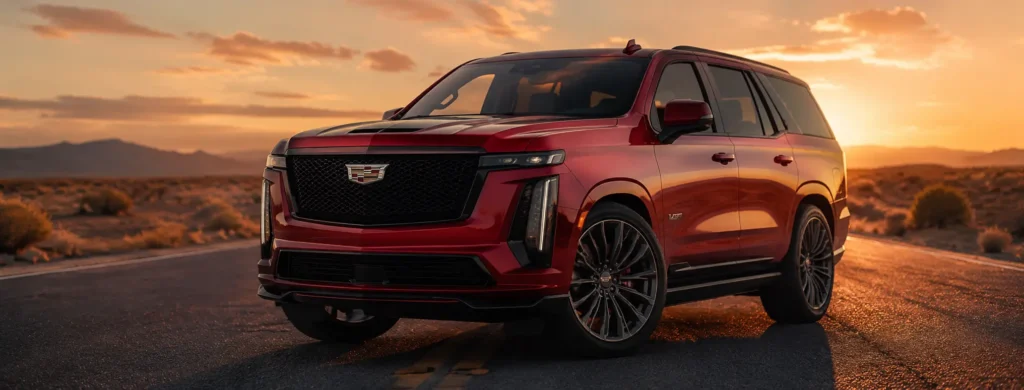
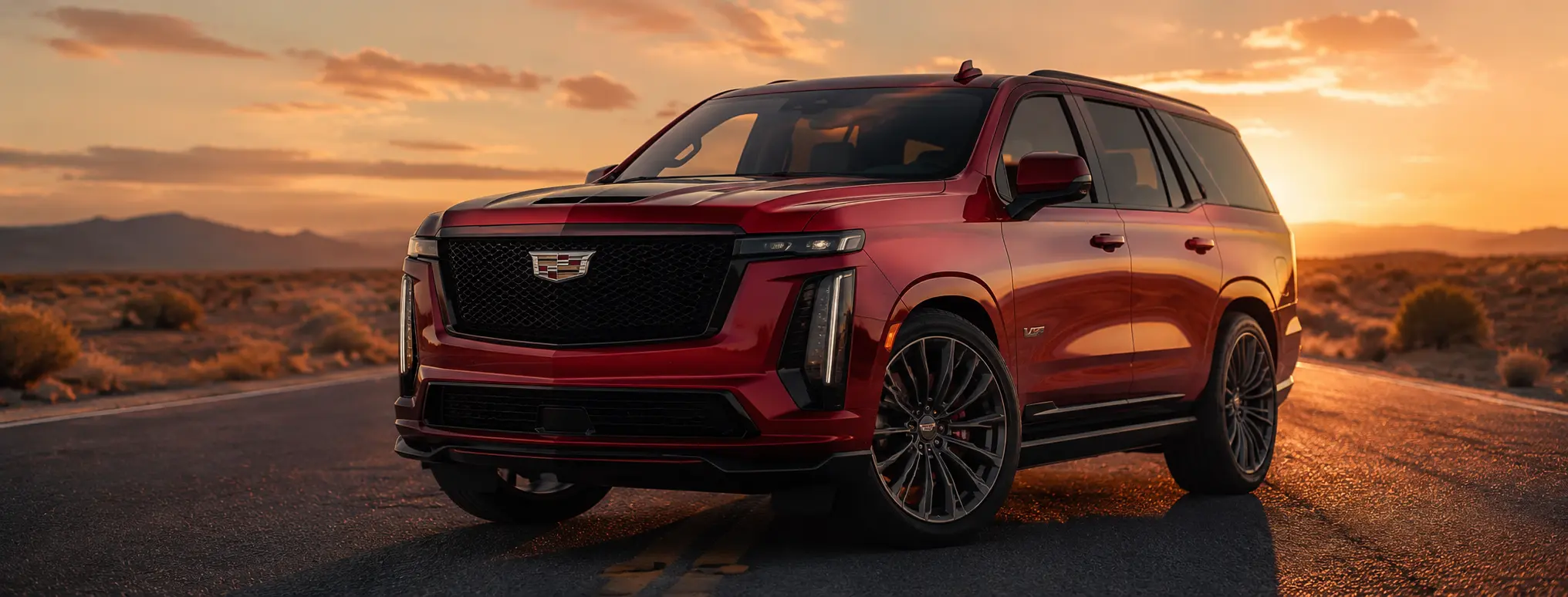
The 2025 Cadillac Escalade V is, by almost any rational measure, a vehicle that doesn’t need to exist. And yet, here it is — a three-ton, full-size luxury SUV powered by a supercharged V8 engine lifted from a genuine performance sedan, wrapped in fresh sheetmetal, and priced well north of $167,000. The fact that it keeps selling says a great deal about what Americans want from a flagship SUV.
This is the most comprehensive breakdown of the 2025 Escalade V available outside of a full road test. Whether you’re seriously considering a purchase, comparing it against the Lincoln Navigator Black Label or the Land Rover Range Rover, or simply curious how Cadillac turned a school-bus-sized people-mover into something that reaches 60 mph in 4.4 seconds — this review covers all of it.
What’s New for 2025 — A Meaningful Mid-Cycle Update
The Escalade V has been around since the 2023 model year, when Cadillac first applied the V-Series badge to its flagship SUV. For 2025, the updates are substantive enough to qualify as more than cosmetic. The front and rear fascias have been redesigned with a sharper, more purposeful look. The illuminated Cadillac emblem at the front is now standard, giving the vehicle a presence after dark that’s difficult to ignore on city streets. New vertical headlights anchor the hood line, slimmer than before and more architectural in character.
The most dramatic exterior change, however, is the move to 24-inch wheels — the first time this size has been offered on any Escalade. On paper, rolling larger rubber under a vehicle this size sounds like a styling exercise. In practice, those 24s do fill the arches in a way that makes the previous 22-inch setup look almost restrained by comparison. Interestingly, reviewers who drove the car back-to-back with the outgoing model noted the proportions feel cohesive rather than oversized, partly because the Escalade’s overall footprint is just enormous.
Inside, the cabin has been redesigned around a striking new pillar-to-pillar infotainment display — a 55-inch curved LED screen that stretches the full width of the dashboard. Cadillac borrowed the concept directly from the Escalade IQ, its electric sibling. The cockpit is heavily accented with carbon fiber trim, distinguishing the V from the standard Escalade lineup visually while reinforcing the performance positioning. A 5G mobile Wi-Fi hotspot is now standard equipment.
Performance: The Supercharged V8 Up Close
The powertrain is unchanged from launch, which isn’t a criticism — the engine is one of the more characterful units in GM’s recent history. It’s the same supercharged 6.2-liter V8 found in the CT5-V Blackwing performance sedan, rated at 682 horsepower and 653 lb-ft of torque. Those numbers feed through a 10-speed automatic transmission and a full-time AWD system that manages delivery across all four wheels.
“
“If you remember nothing else about Cadillac’s flagship SUV, know that it’s just completely ridiculous. And by ridiculous, I mean glorious.”
— CarBuzz, 2025 Cadillac Escalade V Road Test Review
The 0–60 figure of 4.4 seconds is a verified manufacturer claim, and it tells a story that raw horsepower numbers alone do not. This is a vehicle that weighs approximately three tons fully loaded. Accelerating something that heavy to highway speed in under five seconds requires not just power but also very competent chassis management. Cadillac’s Magnetic Ride Control 4.0 suspension system handles that side of the equation, adjusting damping rates in real time to keep the body composed during hard acceleration and cornering.
The braking hardware is equally serious. Brembo front calipers are fitted as standard — the same supplier that equips genuine sports cars — gripping rotors sized to haul the Escalade V down from speed with confidence. An electronic limited-slip differential helps distribute torque at the rear axle during spirited driving or when traction conditions get complicated.
Cadillac’s V-Mode system allows the driver to configure the powertrain, suspension, and exhaust note across several preset modes. In more aggressive settings, the exhaust makes itself heard — a sound note that, according to the Escalade V’s own engineers, was “turned down to an 11” for the 2025 model year. In practice, the updated active noise cancellation means highway cruising is noticeably quieter than the original 2023 model, while still allowing the V8 to announce itself when provoked.
Top speed is electronically capped at 124 mph. Towing capacity is rated at 7,200 pounds — appropriate for boats, trailers, and the kind of equipment that wealthy buyers in Texas and Michigan tend to haul.
Interior, Technology & the 55-Inch Display
The biggest single change to the 2025 Escalade V’s cabin is the new pillar-to-pillar LED display. Spanning 55 inches, it houses the main infotainment interface, the digital instrument cluster, and a passenger-side entertainment screen within a single, seamlessly curved panel. Cadillac’s Google-built infotainment platform underpins the software, which allows the system to handle navigation, media, climate, and vehicle settings within a unified interface. Android Auto and Apple CarPlay are supported.
Beyond the headline display, the cabin experience is built around materials that justify the price more convincingly than the screen does. Semi-aniline leather upholstery covers the front seats, which are 16-way power adjustable with heating, ventilation, and massage functions as standard. The panoramic Ultra View sunroof opens the roof to the sky for all three rows. Audio duties fall to the 36-speaker AKG Studio Reference system — a setup derived from professional monitoring equipment, not the kind of branded audio partnership that amounts to a sticker on a standard speaker grille.
The standard-wheelbase Escalade V seats up to seven passengers. Those who want additional space can opt for the ESV (Extended SUV) version, which stretches the wheelbase and adds cargo capacity behind the third row. For families who need serious hauling ability without sacrificing any of the performance features, the ESV at $170,400 before destination is the practical choice within the V lineup.
An optional Executive Second-Row Seat Package ($7,500) reconfigures the second row into captain’s chairs with enhanced adjustability and a more lounge-like seating position — turning the Escalade V’s middle row into something closer to a private aviation cabin. With this package fitted and a premium color selected, tested examples have been observed well above $178,000 on the window sticker.
Safety Systems & Super Cruise
The Escalade V comes with Super Cruise standard — General Motors’ hands-free highway driving system, which now operates across more than 700,000 miles of roads in the United States and Canada. Super Cruise uses a combination of LiDAR map data, GPS, cameras, and radar sensors to manage lane centering, speed, and distance management on approved roads without requiring the driver to keep their hands on the wheel. An infrared camera monitors the driver’s face to ensure attention is maintained.
The system has been widely praised in automotive media as among the best Level 2 driver assistance systems currently available on any production vehicle — a claim supported by several years of reviews across the GM product lineup. It’s particularly well-suited to the Escalade V’s role as a long-distance touring machine, where covering hundreds of interstate miles becomes measurably less fatiguing.
Beyond Super Cruise, the 2025 model adds Intersection Automatic Emergency Braking, which addresses one of the more common real-world collision scenarios — vehicles running red lights or failing to yield at junctions. The HD Surround Vision system provides a 360-degree camera view around the exterior, essential when parking a vehicle that exceeds 17 feet in length. Forward Collision Alert, Lane Change Alert, Rear Cross-Traffic Alert, and Enhanced Automatic Park Assist are all standard.
The Escalade V also includes an available night vision system, which uses infrared imaging to identify pedestrians and large animals ahead of the vehicle in low-light conditions — an appropriate feature for an SUV that buyers frequently take on long rural highway runs. The Air Ride Adaptive Suspension adjusts automatically to road conditions, lowering the ride height at speed for improved aerodynamics and stability.
It’s worth contextualizing just how much the broader automotive technology conversation has evolved around vehicles like this one. The AI governance challenges facing enterprise technology have parallels in how automakers are managing the deployment of semi-autonomous systems — ensuring these tools remain genuinely useful without overpromising their capabilities to buyers.
Pricing, Trims & the Real Cost of Ownership
The Escalade V comes in a single trim level — there is no base or mid-level to navigate. You are buying the most comprehensively equipped version of Cadillac’s most powerful vehicle, full stop. The standard-wheelbase model starts at $167,400 before destination. The ESV starts at $170,400. As noted, adding the Executive Second-Row Seat Package and a non-base exterior color can push the final transaction price above $178,000.
Fuel costs are a real consideration. The EPA rates the Escalade V at 11 mpg in city driving, 17 mpg on the highway, and 13 mpg combined. In one real-world mixed-suburban test conducted by The Drive, the trip computer showed an average of 10.9 mpg over 118 miles — broadly consistent with EPA estimates. Highway driving improved the average considerably, with one reviewer logging approximately 16.5 mpg on a dedicated highway leg. For reference, a driver covering 15,000 miles annually at a combined 13 mpg would require roughly 1,154 gallons of premium-grade fuel per year.
Cadillac’s standard warranty package applies: four-year/50,000-mile bumper-to-bumper coverage and a six-year/70,000-mile powertrain warranty. Extended service plans are available through Cadillac dealerships and are worth serious consideration given the complexity of the supercharged engine and the air suspension system.
As a traditionally fueled vehicle, the Escalade V does not qualify for any federal EV tax credits under current legislation. This is a significant contrast with the Escalade IQ, which sits in a different purchase calculation entirely for buyers focused on total cost of ownership. Those exploring the wider world of growth enterprise sectors and investment trends will recognize that the shift in luxury automotive purchasing behavior — particularly around electrification — is one of the more consequential consumer trends of the mid-2020s.
How the Escalade V Compares to Its Rivals
The high-performance full-size luxury SUV segment is narrow but competitive. Here is where the 2025 Escalade V sits relative to its most direct competitors, based on publicly available specifications and pricing.
Lincoln Navigator Black Label: Starting in the $105,000–$115,000 range, the Navigator undercuts the Escalade V significantly on price. Its 3.5-liter twin-turbocharged V6 produces 440 horsepower — substantial, but a different experience from the supercharged V8. The Navigator’s interior is arguably more refined in material quality, and its standard wheelbase is less ungainly in urban environments. What it lacks is the V’s visceral character.
Jeep Grand Wagoneer L: The Wagoneer competes at a lower price point and targets buyers who want American luxury with genuine off-road credentials. It doesn’t challenge the Escalade V’s performance numbers, but its interior wood and leather appointments and the brand’s heritage make it a surprisingly strong consideration for buyers less focused on raw acceleration.
BMW Alpina XB7: One of the more direct European analogues. The XB7 uses a 630-horsepower 4.4-liter twin-turbocharged V8 and starts around $145,000. It’s quieter than the Escalade V, subtler in its visual presence, and arguably more driver-focused in its handling character. Buyers who want a fast full-size luxury SUV without the Escalade’s cultural weight often find their way here.
Range Rover Sport SVR: The 575-horsepower supercharged V8 Range Rover Sport SVR is closer in concept to the Escalade V than its positioning suggests. It’s smaller, handles more nimbly, and carries deep brand prestige in global markets. But it lacks the outright power, the American interior scale, and the sheer visual dominance that the Escalade commands.
“The Escalade has always carried a certain cachet that other SUVs struggle to match. It’s huge and makes no apologies for it. Plus, it’s one of the great symbols of American luxury.”
— Edmunds Editorial Review, 2025
Final Verdict — Who Should Actually Buy This?
The 2025 Cadillac Escalade V is an excellent product for a specific kind of buyer. It is not a rational purchase — the fuel economy is poor, the price is steep, and the Escalade IQ offers a compelling alternative if outright performance isn’t the primary goal. But that framing misses what the Escalade V actually is.
It is Cadillac’s most complete expression of what American performance luxury looks like in 2025. The supercharged V8, the 55-inch display, the 36-speaker audio system, the Brembo brakes, the 24-inch wheels — none of these exist independently. They form a coherent statement about what the Escalade V’s buyers want: everything, all at once, in the biggest possible package.
The 2025 updates make a strong model measurably better. The refreshed exterior is sharper and more distinctive. The 55-inch display resolves the biggest interior criticism of the previous generation. The move to 24-inch wheels, while primarily visual, completes the proportional story of the exterior design. The refinement of the exhaust and noise management means the Escalade V is now slightly easier to live with daily without losing the character that makes it interesting in the first place.
If you need to seat seven people, tow a boat, cover a thousand miles in a weekend with Super Cruise engaged, and arrive somewhere with an entrance — the 2025 Cadillac Escalade V is one of a very small number of vehicles that does all of it in a single trip.