

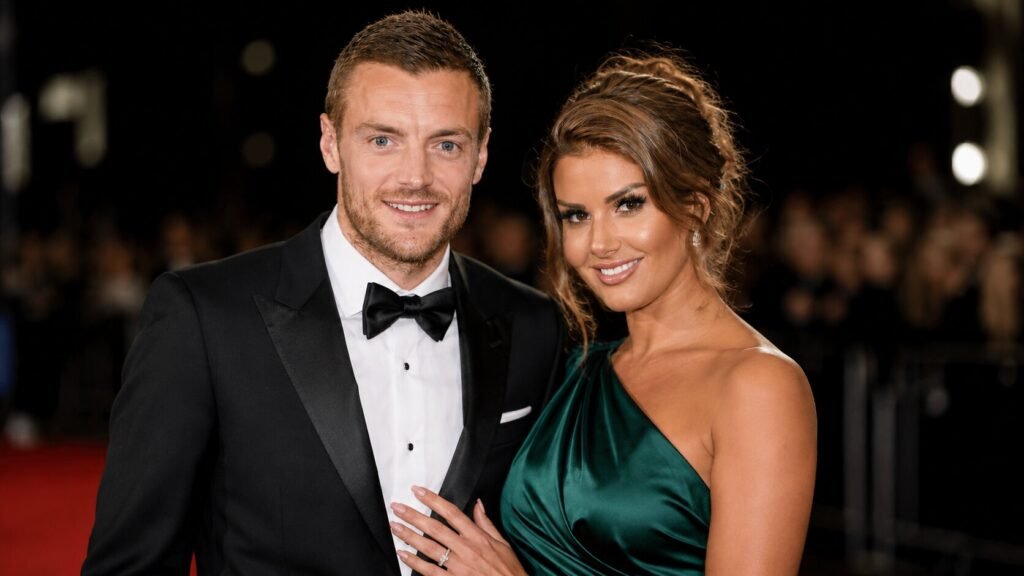
Rebekah Vardy did not choose to become a household name through a body of work in the conventional sense. She became one through a Twitter post that wasn’t even about her — Coleen Rooney’s 2019 accusation that Vardy’s Instagram account had been leaking stories to the press, an episode nicknamed “Wagatha Christie” — and the libel trial it eventually produced, which she lost. That single case now sits at the centre of her public identity, ahead of reality television appearances, a marriage to Leicester City’s Premier League-winning striker Jamie Vardy, and a personal history involving the Jehovah’s Witnesses community she has said covered up abuse she suffered as a child. In 2026, with the family relocated to Italy following Jamie’s move to Cremonese, Vardy remains one of the most litigated-about and least straightforwardly understood figures in British celebrity culture.
Origins: Norwich, Divorce, and a Childhood She’s Spent Years Explaining
Rebekah Vardy — born Rebekah Miranda on 17 February 1982 in Norwich — has given a version of her early life across multiple interviews and one documentary that is more consistent than most tabloid biography would suggest, even if the details are sparse. Her parents, Carlos Miranda and Alison Nicholson, divorced when she was 11, after which the family moved repeatedly between Norwich, Reading and Oxford. Her father, born in Madeira, makes her half-Portuguese by descent — one of the few uncontested biographical facts that gets repeated accurately across coverage.
The more difficult material concerns her upbringing within the Jehovah’s Witnesses. Vardy has said she was sexually abused by a family friend as a child, and that the abuse was covered up by community leaders — an account she gave in detail in the 2023 documentary Rebekah Vardy: Jehovah’s Witnesses and Me, reviewed by The Guardian as considerably more affecting than her tabloid reputation would suggest. She has also said she was made homeless at 15, attributing the breakdown to a fractured relationship with her mother and stepfather. Her educational background beyond this point has not been publicly documented, and no verified source specifies which schools she attended or to what level.
A Family Formed Before Jamie Vardy Existed in Her Story
It matters to Vardy’s biography that she was a mother of two well before she met her future husband. Her eldest child, a daughter, was born in the mid-2000s — sourcing on the precise year is inconsistent, with some outlets citing 2003 and others 2005 — and Vardy has never publicly named the child’s biological father, a position she has held firmly for two decades. A son followed in 2010, from a roughly six-year relationship with semi-professional footballer Luke Foster. Both children were later legally adopted by Jamie Vardy when the couple married in 2016, formalising his status as their father rather than leaving it as an informal stepparent arrangement — a distinction frequently lost in recycled online content about the family.
Vardy met Jamie in 2014, while working in Leicester nightlife and organising his birthday celebration. The relationship moved quickly by her own account: she has described it as the first relationship in which she felt genuinely stable, telling Fabulous magazine that trust “took a while” but that Jamie was unlike previous partners in his consistency. They married at Peckforton Castle in Cheshire on 26 May 2016, having already had their first child together, Sofia, born in 2014. Two more children followed: son Finley Jaiden in January 2017, and daughter Olivia Grace on 28 December 2019, whose name the couple withheld publicly for roughly two weeks before confirming it through a Hello! magazine feature.
“I love and trust him. My husband ain’t like the rest of them… He knows the battles I’ve endured and where I’ve come from to where I am now.” — Rebekah Vardy, in an interview with Fabulous magazine
Vardy has also spoken about postnatal depression following one of her pregnancies, saying she pursued cognitive behavioural therapy to work through it — a disclosure that sits at odds with the combative public persona built around her by the press, and one that gets far less circulation than the Wagatha Christie material.
Reality Television as a Career Strategy
Vardy’s public profile predates the Rooney case by two years. She appeared on ITV’s I’m a Celebrity… Get Me Out of Here! in November 2017, finishing third to be eliminated, and used the platform to disclose her postnatal depression to a national audience for the first time. She returned to reality television with Dancing on Ice in 2021, exiting after a skate-off in February that year. Between these appearances she built a recurring presence as a guest panellist on Loose Women, the format that most consistently placed her in front of a British daytime audience on her own terms rather than as an adjunct to her husband’s football career.
That pattern changed in 2026. Vardy and Jamie became the subjects of The Vardys, an ITV reality series following the family’s relocation to Italy after his transfer to Serie A club Cremonese. The show places several of the couple’s children on screen — Megan and Taylor among them — while Jamie’s eldest daughter, Ella, from a prior relationship with Emma Daggett, is notably absent, consistent with her lifelong separation from the rest of the Vardy household as publicly documented.
Vardy’s published work includes children’s books co-authored with Jamie, among them Cedric: The Little Sloth with a Big Dream (2022), a lower-profile but genuine credit that tends to be omitted from summaries fixated on the litigation.
The Case That Defines Her Public Record
No account of Rebekah Vardy is complete, or honest, without the Wagatha Christie trial, because it is the single episode most responsible for how the public understands her credibility.
The dispute began in October 2019, when Coleen Rooney announced she had run a private sting: restricting access to her Instagram account down to a single follower — Vardy’s — and watching to see whether the stories she posted on it, including a fabricated claim about a “gender selection” trip to Mexico, subsequently appeared in The Sun. When they did, Rooney published her conclusion directly, closing with the now-famous line, “It’s……….Rebekah Vardy’s account.” Vardy denied leaking anything and sued for libel, arguing the accusation had exposed her to “public abuse on a massive scale.”
The case went to trial at the High Court in May 2022. On 29 July 2022, Justice Karen Steyn ruled against Vardy, finding it “likely” that Vardy’s then-agent, Caroline Watt, had directly passed information to The Sun, and that Vardy “knew of and condoned” the practice — directing Watt toward the private account, forwarding screenshots, and flagging items of press interest. Steyn’s written judgment also noted that Vardy’s evidence during the trial was, on several occasions, “manifestly inconsistent,” and that she had exhibited “a degree of self-deception” about her own involvement. The court ordered Vardy to pay a substantial initial sum toward Rooney’s legal costs, with total liability capped at a higher figure — the exact final settlement between the parties has not been fully disclosed in verified reporting, and readers should treat specific pound figures circulating online with caution unless sourced to court documents or confirmed statements from either party’s representatives.
Rooney, for her part, called the outcome vindicating but noted publicly that she had never wanted the case to reach trial, citing its cost during a period of economic hardship for ordinary households — a comment that drew its own scrutiny given the sums involved on both sides.
What the Case Changed, and What It Didn’t
The trial’s cultural afterlife has arguably outpaced its legal substance. “Wagatha Christie” entered the language as shorthand for any story-leaking scandal among public figures, and Vardy’s name is now inseparable from the term regardless of what else she does professionally. That association has coexisted, somewhat uneasily, with her continued presence on British television and her family’s ongoing relocation to Italy, which The Vardys has turned into fresh content rather than a retreat from public life.
What the case did not do is end her marriage or visibly damage her standing with Jamie, whose support for her throughout the trial was reported consistently and has not been publicly contradicted. Whether the judgment altered her standing with the wider “WAG” community she has been associated with since the mid-2010s is harder to verify — public reporting on that front consists mostly of speculation rather than on-record accounts from the women involved.
The Discrepancy Worth Naming
Much of what appears online about Rebekah Vardy’s biography — her children’s exact birth years, the final cost figure from the libel case, details of her early life beyond what she has disclosed herself — varies meaningfully from one aggregator to the next, often because each new article rewrites the last one rather than returning to primary reporting. This piece has flagged those gaps rather than resolving them with invented precision. What remains solid is the record itself: a woman who built a media career independent of her husband’s fame, disclosed real mental health struggles at a moment when doing so was unfashionable, and lost a very public court case in terms unusually blunt for a High Court judgment — and who has continued working regardless.