

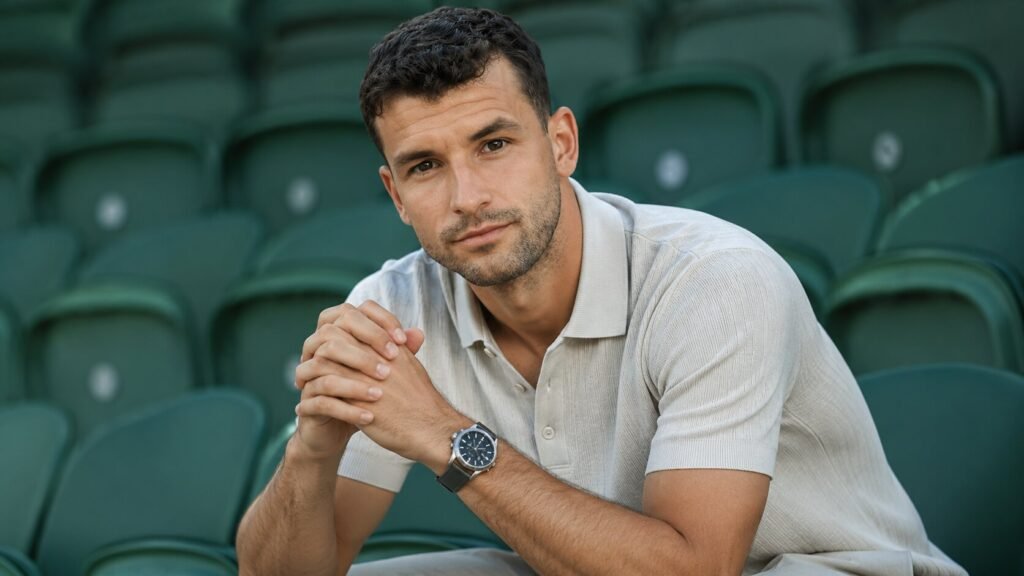
Grigor Dimitrov spent the past twelve months answering a question few athletes ever have to face twice: what do you do when the game you love physically breaks you on its biggest stage, in full view of the crowd that made you love it? On 4 July 2026, at Wimbledon, the 35-year-old Bulgarian beat Matteo Berrettini in five sets to reach the fourth round — a year, almost to the day, after he retired from a two-sets-to-love lead against Jannik Sinner with a torn pectoral muscle on the same grass. He arrived at this year’s tournament as a wildcard, ranked outside the world’s top 140. That gap between where he was and where he is says more about Dimitrov’s career than any highlight reel from his 2017 peak.
The Player Before the Comeback
Dimitrov was born on 16 May 1991 in Haskovo, Bulgaria, and turned professional in 2008 after a junior career that made him, briefly, the most talked-about teenage prospect in men’s tennis. He finished 2007 as junior world No. 1 and, in 2008, won the boys’ singles titles at both Wimbledon and the US Open — a double that had previously been managed by Roger Federer and Stefan Edberg among former champions, and it was that stylistic resemblance, particularly his one-handed backhand, that saddled him early with the nickname “Baby Fed.” Federer himself found the comparison wearing on Dimitrov rather than flattering, telling reporters in 2013 that it was “funny” at first but became “annoying.”
The professional career that followed had a slower arc than the junior hype suggested. Dimitrov became the first Bulgarian man to win an ATP Tour singles title, at the 2013 Stockholm Open, and broke into the top ten for the first time in July 2014 off the back of a run to the Wimbledon semifinals — where he lost to Novak Djokovic, the eventual champion, having upset then-defending champion Andy Murray in the quarterfinals. That result remains one of three Grand Slam semifinal appearances in his career, alongside the 2017 Australian Open and the 2019 US Open.
2017: The Year Everything Aligned
The season that defines Dimitrov’s ceiling came three years later. Working with coach Daniel Vallverdu, he won titles in Brisbane and Sofia before claiming his first ATP Masters 1000 title in Cincinnati. The year’s biggest result arrived at the season-ending ATP Finals in London, where Dimitrov, seeded sixth, went a perfect 5–0 through round-robin and knockout play to beat David Goffin in the final, 7–5, 4–6, 6–3. He was the first debutant to win the title undefeated since John McEnroe in 1978. The win pushed him to a career-high ranking of world No. 3 on 20 November 2017, making him the highest-ranked Bulgarian player, male or female, in the sport’s history.
He has never returned to that ranking since. What followed instead was a career of high-quality but scattered results — a run to the 2019 US Open semifinal as an unseeded No. 78 that included his first win over Federer in eight meetings, a Masters 1000 final at the 2023 Paris Masters, and another at the 2024 Miami Open, where he lost to Sinner after beating Carlos Alcaraz in one of the more talked-about matches of that season. By reaching the 2024 French Open quarterfinals, he became only the second player born in the 1990s, after Daniil Medvedev, to complete a career set of quarterfinal appearances across all four majors and all Masters 1000 events — a durability statistic that gets far less attention than his early “Baby Fed” branding ever did.
Personal Life: What’s Actually Confirmed
Dimitrov’s off-court profile has, at times, drawn as much coverage as his results, largely due to two relationships with high-profile partners: tennis player Maria Sharapova, whom he dated for roughly two years until 2015, and singer Nicole Scherzinger, with whom he was linked from around 2016 into 2019. Both relationships were widely reported in mainstream press at the time, and Dimitrov has spoken publicly, if sparingly, about the personal disruption following the end of the Sharapova relationship affecting his form. Beyond these confirmed public relationships, further specifics of Dimitrov’s personal life have not been extensively detailed in verified interviews, and this piece does not speculate beyond what he and his representatives have put on the record.
The Injury, and What It Actually Cost Him
The defining moment of Dimitrov’s recent career happened in slow motion, in front of a global television audience. In the fourth round of Wimbledon 2025, leading Jannik Sinner two sets to love and playing, by his own and others’ accounts, some of the best tennis of his career, Dimitrov tore his pectoral muscle mid-serve. He was forced to retire on the spot. He has since described crying for two hours afterward before going straight to hospital.
What separates this from a standard sports-injury narrative is what Dimitrov has said about the psychological aftermath, which he detailed candidly to reporters ahead of this year’s tournament. He described being “frightened” of returning to the court, of flashbacks the moment he began tossing a ball again, and of an “inner chatter” he called unhealthy that lingered for months. He played only one further match in 2025, at the Paris Masters in late October, before shutting his season down. His ranking, which had sat at No. 10 entering 2025, collapsed to as low as 164 by mid-2026 as he lost seven of his last eight matches through the spring, including opening-round exits in nine of eleven tournaments before the grass season — Brisbane, Dallas, Acapulco, Miami, Monte-Carlo and Madrid among them, plus Roland Garros qualifying.
Rebuilding: Nalbandian, Malisse, and the Slow Climb Back
Facing the steepest ranking drop of his career, Dimitrov overhauled his team. He ended his long-running partnership with coaches Dani Vallverdu and Jamie Delgado in 2025 and began working with former world No. 3 David Nalbandian and Xavier Malisse, bringing Nalbandian on formally in mid-February 2026 ahead of the Acapulco event. Dimitrov has credited Nalbandian specifically with reawakening parts of his game and mindset that he described as having gone “a bit covered in dust.”
The results of that reset were incremental rather than dramatic — which, for a player rebuilding from a serious injury and a ranking outside the top 150, is arguably the more honest kind of progress. He won two matches at the Dublin Challenger in June 2026, then reached the quarterfinals in Mallorca, including a straight-sets win over Marc Polmans in which he landed 96% of his first-serve points and picked up the 50th tour-level grass-court win of his career. “It’s been a difficult time, but I’m very happy at the moment,” he said afterward. “I’m trying to lower my expectations on any surface I play, but the first set today was a reminder that I’m still fairly decent.”
Wimbledon 2026: Full Circle, on Purpose
Dimitrov needed a wildcard to enter this year’s Wimbledon main draw, ranked 146th in the world. He opened with a three-set win over Dane Sweeny, then produced what multiple outlets called one of the standout performances of the tournament’s second round, beating 15th seed and Roland Garros semifinalist Jakub Menšík 7–6(5), 4–6, 7–5, 6–3 — a result that returned him to the same grass court, almost exactly one year on from the Sinner retirement. He was visibly emotional afterward, telling the crowd he felt “loved” and “supported,” his voice trailing off mid-sentence when asked about the first match of the tournament.
His third-round win over Matteo Berrettini, another player with his own extensive injury history, went the full five sets and pushed his run to the fourth round, where he was scheduled to face Britain’s Arthur Fery. It is Dimitrov’s best Wimbledon result since his run to the semifinals in 2014 — assuming he advances no further, it already stands as a career-arc footnote few would have predicted twelve months ago, when he was lying face down on the same grounds unable to finish a match.
Why This Moment Matters More Than the Ranking Suggests
There is a version of Dimitrov’s story that ends at 2017 — a talented player who reached No. 3, won the biggest title of his career, and gradually faded into journeyman status. The more accurate version, based on what’s verifiable now, is a career punctuated by two distinct comebacks: one from years of underperforming his junior hype into the 2017 peak, and a second, harder one from a catastrophic injury at 34 back into competitive relevance at 35. Whether the second run extends beyond this Wimbledon remains genuinely uncertain — public reporting on his longer-term plans, including whether he intends to keep playing into 2027, has not been confirmed by Dimitrov or his team. What’s already on the record, though, is a level of public vulnerability about the mental toll of injury that is unusual for a player of his generation, and a results curve — from world No. 164 to a Wimbledon fourth round in the space of a month — that is not easily explained by ranking-points arithmetic alone.