

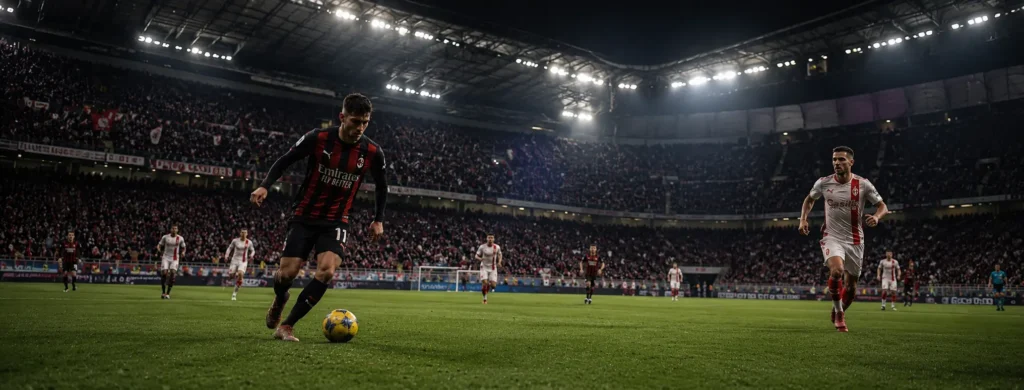
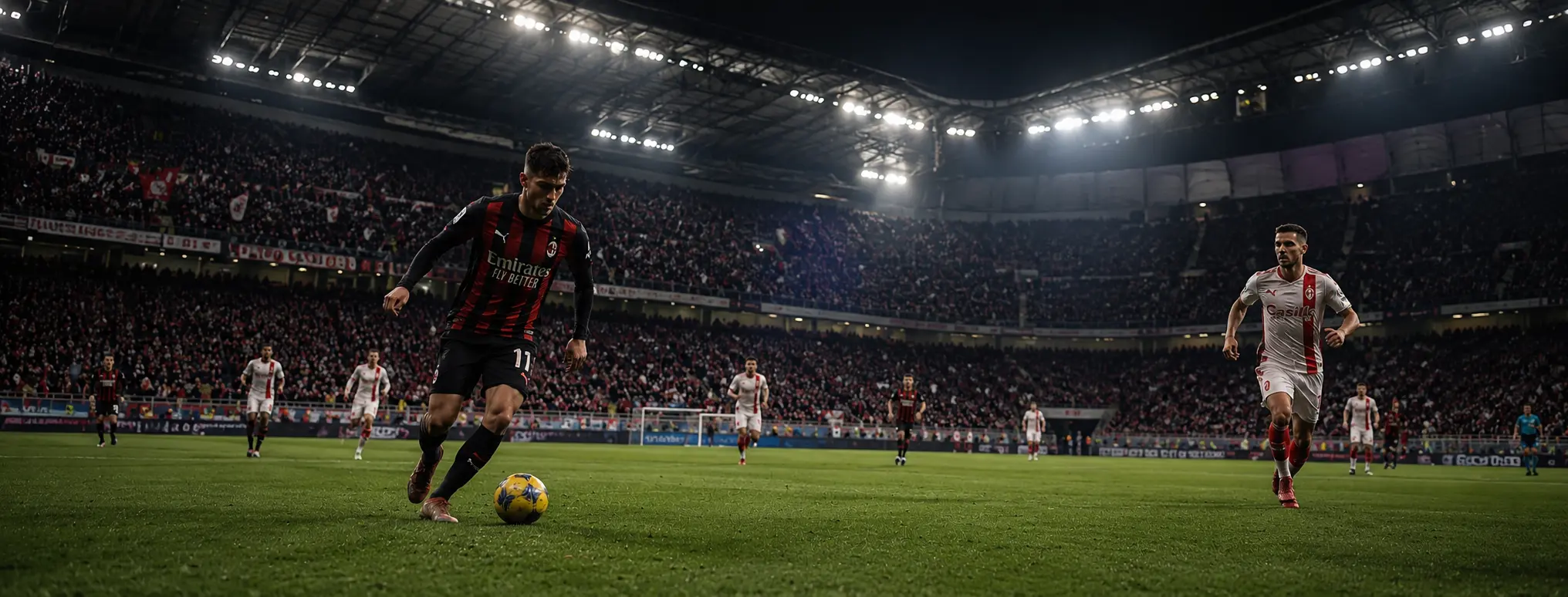
The AC Milan vs SSC Bari timeline stretches back nearly a century, covering some of Italian football’s most instructive contrasts. It is not the Derby della Madonnina, nor does it carry the generational weight of the Juventus–Inter rivalry. But across 77 official matches and nearly 100 years, it has produced moments — record hammerings, genuine upsets, and a 2025 Coppa Italia reunion — that both sets of supporters still reference with conviction.
On one side stands AC Milan, founded in 1899 by English expatriates, a club that has won the UEFA Champions League seven times and collected nineteen Serie A Scudetti. On the other, SSC Bari — the Galletti, or Roosters — a southern Italian club founded in 1908 whose history is defined less by silverware than by survival, regional identity, and the occasional result that defies expectation entirely.
Understanding this fixture requires understanding why it is so intermittent. Milan has spent the vast majority of the post-war era in Serie A. Bari, by contrast, have shuttled between the top flight and Serie B for decades. Their meetings only occur when both clubs share the same division, or when a Coppa Italia draw pairs them. That structural reality explains the long silences and sudden reappearances that give this timeline its unusual rhythm.
Club Origins & Contrasting Identities
AC Milan and SSC Bari were born into very different worlds, and those worlds have never fully converged. Milan was established in 1899 by English and Swiss expatriates living in the industrial north, initially under the name Milan Cricket and Football Club. Within three decades, the club had evolved into a serious domestic force, attracting star players from across Europe and building the San Siro — Stadio Giuseppe Meazza — into one of the sport’s most recognizable venues.
SSC Bari, established in 1908, grew out of a different context entirely. The club is rooted in Puglia, a region in southern Italy that has historically been underserved by football’s financial infrastructure. Bari plays its home matches at Stadio San Nicola, a striking modernist arena built for the 1990 FIFA World Cup. The stadium alone holds a certain symbolism — a world-class facility in a city that has spent much of the last three decades fighting to maintain top-flight status.
The Galletti nickname — meaning Roosters — reflects the club’s spirit more than its trophy cabinet. Bari supporters are known for passionate home support, and Stadio San Nicola has occasionally produced the kind of atmosphere that makes large traveling squads genuinely uncomfortable. That home-ground advantage has been relevant across the AC Milan vs SSC Bari timeline more often than the raw statistics might suggest.
Early Encounters: 1928–1960
The first recorded meeting between AC Milan and SSC Bari took place in 1928 and ended in a draw — a result that, in hindsight, slightly flatters the story. Milan scored first, but Bari responded, and the match finished level. It was a modest opening to what would eventually become a fixture with a clear and sustained hierarchy.
Through the 1930s, with Italy’s top division consolidated under the newly structured Serie A format, the two clubs met more regularly than they would in later decades. Milan generally held the advantage in these encounters, winning several matches while Bari managed sporadic results that drew large crowds to both venues. The post-war period, however, is where the most striking entry in this entire timeline sits.
“
“The 9–1 scoreline from December 1949 remains the widest margin in this fixture’s entire history — a result driven by the legendary Gre-No-Li forward trio of Gunnar Gren, Gunnar Nordahl, and Nils Liedholm.”
— GossipWire Football Research Desk
On December 18, 1949, AC Milan defeated SSC Bari 9–1 in Serie A — the single largest winning margin recorded across all meetings between these two clubs. The Gre-No-Li forward line, a trio of Swedish internationals who transformed Milan’s attacking play in the late 1940s and early 1950s, were at the heart of the destruction. Gunnar Nordahl in particular was among the most prolific scorers in Serie A history during this period, and matches like the 1949 rout illustrated why.
From the 1950s through the 1970s, meetings between the two clubs became less frequent. Bari spent extended periods outside the top flight, reducing the fixture to occasional encounters rather than regular season staples. When they did meet, Milan’s superior resources typically produced the expected result, though the margins were rarely as extreme as 1949’s.

Stadio Giuseppe Meazza (San Siro), Milan — home ground of AC Milan and venue for the most recent meeting between these clubs in August 2025.
The Golden Era & Bari’s Rise: 1980–2000
The 1980s marked the most consistent period of top-flight competition between these two sides. Bari established themselves in Serie A with greater regularity through the decade, producing a squad capable of competing with — and occasionally beating — the bigger clubs. It was during this period that the fixture gained some of the emotional weight it carries in Pugliese football memory.
In 1987, SSC Bari defeated AC Milan 2–1 at Stadio San Nicola. The result shocked many observers and remains one of the most celebrated entries in Bari’s matchday folklore against this particular opponent. It reinforced a recurring theme across the entire timeline: that Bari at home, in front of their own crowd, present a genuinely different challenge from the same club playing away in a near-empty San Siro fixture.
Then came the years that transformed AC Milan entirely. Between 1987 and 1995, under coach Arrigo Sacchi and later Fabio Capello, the Rossoneri became arguably the finest club side in Europe. Marco van Basten, Frank Rijkaard, Ruud Gullit, Franco Baresi, and Paolo Maldini formed the backbone of a squad that won back-to-back European Cups in 1989 and 1990. When this Milan met Bari in Serie A, the results were typically lopsided, but the matches still attracted considerable attention simply because of who Milan were.
Through the 1990s, Bari continued to punch above their weight on occasion. Their Serie A periods coincided with some intriguing tactical encounters, particularly in matches at Stadio San Nicola where organized defending and compact midfield lines gave Milan’s attacking players real problems. The 1990 FIFA World Cup had brought global attention to the stadium and the city, and Bari rode that moment of visibility into a period of genuine top-flight ambition.
Italian football supporters who followed this period know that Serie A in the 1990s was genuinely the most competitive domestic league in the world. Bari faced not only Milan during these seasons but also Juventus, Inter, Napoli, and Roma — a circuit of clubs with far deeper resources. Staying in that company, season after season, required a particular kind of organization that Bari managed more often than their eventual relegations might suggest.
Football has always rewarded clubs with long institutional memory. In much the same way that seasoned football families understand the weight of dynasty, clubs like Bari carry decades of tactical learning into each new top-flight stint — knowledge that occasionally produces results that confound the statistics.
Modern Clashes: 2000–2011
The early 2000s brought a period of transition for both clubs, though in very different directions. Milan, under Carlo Ancelotti, built one of the finest squads in European football — Andriy Shevchenko, Andrea Pirlo, Kaká, and Clarence Seedorf among them. They won the Champions League in 2003 and 2007. Bari, meanwhile, spent most of this period outside the top flight, reducing the fixture to a footnote in the decade’s Italian football story.
Bari’s last sustained top-flight spell ran from 2009 to 2011, and it brought the fixture back into focus for a brief but notable chapter. The two clubs met in Serie A during this period, with the matches carrying a competitive edge that the aggregate record between them sometimes obscures. A 0–0 draw at San Siro in the 2009–10 season was a legitimate defensive performance from Bari, holding Milan to nothing in front of their own crowd.
Milan won 3–2 in Bari during the same era — a match that illustrated the compact, attacking football Bari were capable of in front of their home supporters. The scoreline was close enough that a different day might have produced a draw, or even an upset. After Bari’s relegation in 2011, the fixture disappeared from the Serie A calendar entirely, and for the next fourteen years, the two clubs would not share a division.
The 2025 Coppa Italia: Latest Chapter
On August 17, 2025, AC Milan and SSC Bari met for the first time in over fourteen years. The occasion was the Coppa Italia Frecciarossa 2025–26, Round of 64, played at Stadio Giuseppe Meazza in Milan. The attendance was recorded at 71,061 — a substantial crowd for what is technically a first-round cup tie, reflecting the weight that even lopsided fixtures carry when one side is a club of Milan’s stature.
The match began promisingly for Milan, with Rafael Leão opening the scoring in the 14th minute with a header from a Fikayo Tomori cross. The joy was short-lived for the Portuguese winger — he suffered a right calf strain shortly after and was substituted in the 18th minute, replaced by Santiago Giménez. The injury concern immediately overshadowed the early lead and became the story of the first half for the Milan camp.
Christian Pulisic settled the match in the 48th minute, receiving a pass from Giménez, turning inside the penalty area, and finding the bottom-right corner with composure. The final score — AC Milan 2–0 SSC Bari — maintained Milan’s unbeaten record against the Galletti in Coppa Italia competition, extending their run to nine unbeaten matches against Bari in cup football. Pulisic was named Player of the Match with a rating of 8.6.
Bari, managed by Fabio Caserta and working toward a return to Serie A after 14 years outside the top flight, showed defensive discipline throughout. They finished with 33% possession and two shots, neither on target. It was a competitive showing against genuinely superior opposition, though the result was never really in doubt from the moment Milan went ahead. Milan, under newly appointed Massimiliano Allegri — watching from the stands due to a carried-over suspension — deployed a 3-5-2 formation featuring several new signings including Samuele Ricci and Pervis Estupiñán.
“Rafael Leão scored in the 14th minute before being forced off with injury — a bittersweet opening to Milan’s 2025–26 season that confirmed the fixture’s tendency to produce drama beyond the scoreline.”
— GossipWire Editorial Desk
Head-to-Head Statistics & Historical Records
Across all official competitions — primarily Serie A but including Coppa Italia encounters — AC Milan lead the all-time head-to-head record with 51 wins from 77 matches. SSC Bari have won 13, with 13 matches ending level. On goals, Milan hold a reported advantage of approximately 163–56 across their combined Serie A and Coppa Italia history, according to publicly available football statistics databases.
The Series A breakdown, which covers 28 of those meetings, shows Milan winning 16, Bari winning 5, and 7 ending in draws. The gap narrows somewhat in those numbers, which reflects Bari’s competitiveness during their peak Serie A years in the 1980s and 1990s, when they were not simply making up numbers in the top flight but genuinely competing for mid-table positions.
Most Significant Results Across the Timeline
Several results stand out as genuinely defining entries in this fixture’s history. The 9–1 Serie A win for Milan in December 1949 remains the widest margin, powered by the Gre-No-Li forward line and still referenced when historians compare Milan’s greatest attacking periods. At the other end, Bari’s 2–1 victory at Stadio San Nicola in 1987 represents the kind of underdog result that lives long in club folklore — a win against one of the continent’s best sides during a period of genuine Milan dominance.
The 0–0 draw at San Siro in the 2009–10 Serie A season is less dramatic but arguably more instructive. Holding Milan scoreless at home, in front of a packed Meazza, requires a level of defensive organization that Bari demonstrated convincingly on that occasion. It is the sort of result that tells you something about the tactical sophistication Bari are capable of when properly organized, regardless of their league position.
Key Players Across the Eras
For AC Milan, the players who have shaped this particular fixture most visibly include Gunnar Nordahl (1949 era), Marco van Basten (late 1980s), Kaká and Andriy Shevchenko (2000s), and more recently Rafael Leão and Christian Pulisic, both of whom scored in the 2025 Coppa Italia meeting. The consistency of quality across Milan’s decades of participation in this fixture reflects the club’s ability to maintain elite squad depth over time.
For SSC Bari, the contributions have been more episodic. Their best Serie A squads of the late 1980s and 1990s produced moments of genuine resistance, and players who went on to careers at larger clubs often first demonstrated their ability in these high-profile matches against elite northern sides. Bari has historically served as a proving ground for southern Italian talent — a pipeline that Serie A’s larger clubs have tapped regularly over the decades.
The broader world of Italian football has long respected the contribution of clubs like Bari — and the same applies to football families who understand the game at every level. Football dynasties across Europe have shown that talent development and institutional knowledge often matter more than short-term spending — a principle that applies as much to southern Italian clubs as it does to Premier League households.
What the Numbers Actually Tell You
The overall record strongly favors Milan, and that is not a surprise given the structural imbalance between the two clubs. Milan has spent essentially their entire post-war history at the top level with consistent investment, consistent European competition, and consistent access to the world’s best players. Bari has operated on a fraction of those resources, in a football economy where southern Italian clubs begin at a financial disadvantage that is difficult to close.
What makes the 13 Bari victories meaningful is not their frequency but their context. They came against real Milan sides — not weakened cup teams, not mid-season rests. Several came at Stadio San Nicola in front of capacity crowds during Bari’s most competitive Serie A seasons. When Bari beat Milan, they genuinely beat Milan. That distinction matters in any honest reading of this timeline.
Milan’s home record against Bari is particularly dominant, with a win rate cited by multiple football statistics sources as exceeding 90% in home fixtures. Away at Stadio San Nicola, the record tightens considerably, reflecting the genuine challenge Bari’s home environment poses. Any future Serie A reunion would likely reproduce this pattern — comfortable Milan wins at San Siro, tighter and more uncertain contests in Puglia.
What Comes Next
As of the 2025–26 season, SSC Bari remain in Serie B and are working toward promotion back to the top flight for the first time since 2011. Should they earn that promotion, the fixture with Milan would return to the Serie A calendar for the first time in over fifteen years. Milan, meanwhile, continue to compete in Serie A and European competition under Massimiliano Allegri’s management.
The Coppa Italia remains the most realistic short-term meeting point if Bari remain outside the top flight. Early cup rounds consistently pair Serie A and Serie B sides, and any draw that sends Milan to Puglia or brings Bari to the San Siro would add another entry to a timeline that has been building since 1928. Neither club nor their supporters would treat such a match as merely procedural.