

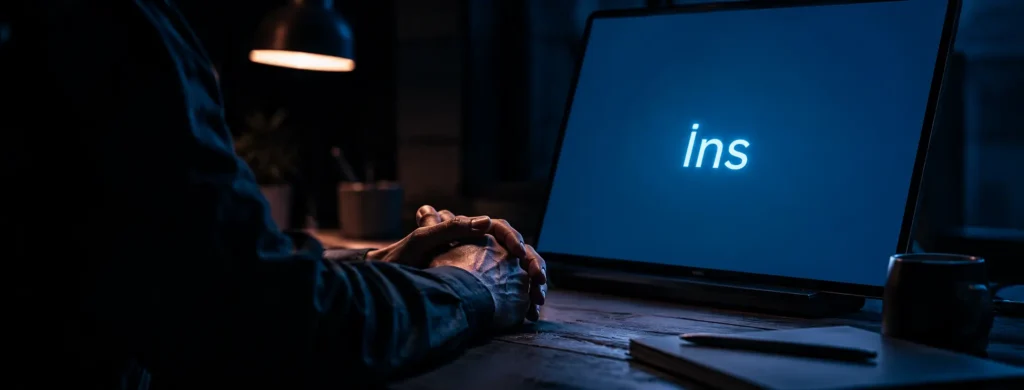

Three letters. One small dot above the capital I. And behind it, a concept that quietly cuts through one of the loudest problems in modern digital life — the growing distance between the person behind a profile and the image that profile projects. That is what İns is, and that gap is exactly what it has been filling.
İns is a digital identity marker that has gained visibility across platforms like Instagram, TikTok, and X — not through coordinated campaigns or viral moments, but through something slower and more organic: genuine resonance. It sits in bios, hashtags, and creative profiles as a compact signal of authenticity and human presence. For users who have grown tired of algorithmic performance culture, it functions as a quiet pushback — a way of saying, without much noise, that there is a real person here.
What makes İns worth examining closely is not just its spread across platforms, but what that spread reveals about how digital identity is shifting. The word is rooted in a specific linguistic tradition, carries a philosophical weight that casual users may not immediately register, and operates within a broader cultural moment in which authenticity has gone from aspiration to active demand. Understanding İns means understanding something real about where online self-expression is heading.
What Is İns? The Core Definition
İns is a symbolic digital identity marker — a compact, visually distinctive term used across social media profiles, bios, hashtags, and creative projects to signal authenticity, human presence, and intentional self-expression. It does not carry a single fixed dictionary definition, which is part of the point. Its meaning is community-shaped and context-driven, which gives it a flexibility that rigid labels tend to lose over time.
What separates İns from run-of-the-mill internet slang is the specificity of its typography. The dotted İ is not the standard Latin “I” seen in English-language text — it is a character from the Turkish alphabet, where the distinction between dotted İ and dotless I carries genuine linguistic significance. That small detail is not accidental. It signals cultural awareness, visual intentionality, and a kind of care that feels different from the casual shorthand dominating most online communication.
In practical terms, users encounter İns as a profile tag, a caption element, a hashtag, or a standalone word in creative work. Its interpretation shifts by context. For some, it signals membership in a community that values realness over performance. For others, it functions as a minimalist brand identifier — a way to attach a coherent identity to disparate content without overexplaining. Some communities have proposed expansions of the acronym, including “Individuals Networking Socially,” “Identity in Networked Spaces,” or “Influencers Navigating Society,” though none of these has become the official definition. The openness is intentional and structural.
“
“İns isn’t a brand. It’s not a product. It’s a cultural signal that says: I’m here, I’m real, and I exist beyond the algorithm.”
— Top Spot Magazine, Digital Culture Analysis, 2025
The core of what İns communicates is this: in a digital environment saturated with AI-generated content, optimized posts, and personas built for engagement metrics, İns insists on personhood. It is a reminder — subtle, but clear — that behind the profile, the username, the carefully curated feed, there is a human being with an interior life that no algorithm can fully represent. That insistence resonates across cultures and platforms, which explains why a term with Turkish linguistic roots has found an audience far beyond its geographic origin.
Linguistic Origin — Rooted in the Turkish Word for Human
The word İns derives from the Turkish term insan, meaning “human being” or simply “human.” This is not a loose etymological connection — it is the conceptual foundation of the entire identity marker. When users apply İns to their profiles or creative work, they are, consciously or not, invoking that root: I am a person. I am not a bot, a brand account, a content machine, or a digital construct. I am human.
The Turkish alphabet distinguishes between two forms of the letter I. The dotted İ (uppercase) and i (lowercase) represent one sound, while the dotless I (uppercase) and ı (lowercase) represent a different sound entirely. This is not a matter of font style or typographic decoration — these are distinct letters with distinct phonetic values, a feature of Turkish orthography that has no direct parallel in English. When İns is written with the dotted İ, it is signaling that the word belongs to this specific tradition, one where such precision is built into the writing system itself.
That detail matters in the context of digital culture because it immediately communicates intentionality to anyone who notices it. Using the dotted İ rather than the standard Latin I is not accidental on a standard QWERTY keyboard — it requires deliberate effort. That effort is itself a signal, communicating cross-cultural awareness, attention to visual detail, and a refusal to simply default to the path of least resistance. For communities that value authenticity and deliberate self-expression, those qualities have genuine currency.
Turkish is spoken natively by approximately 80 million people, primarily in Turkey, with significant communities across Germany, the Netherlands, and broader diaspora populations in Europe. The Turkish language has been an active presence on global digital platforms for decades, and the intersection of Turkish linguistic tradition with English-dominated internet culture is not new. What is notable about İns is that it represents a case where a piece of Turkish linguistic infrastructure — the dotted İ distinction — has been consciously adopted by digital users beyond that immediate cultural context, valued precisely because of the deliberateness it signals.
İns in Digital Culture & Social Media
Social media ecosystems have always generated their own compressed languages — shorthand terms, symbols, and markers that carry meaning within specific communities before potentially crossing over into wider use. İns fits within that tradition, but it arrived during a specific cultural moment that gave it particular relevance. The early-to-mid 2020s saw growing fatigue with what researchers and commentators describe as performative authenticity: the practice of curating a relatable, “real” online presence as a deliberate strategy, indistinguishable in practice from the polished personal branding it was supposedly reacting against.
Into that environment, İns arrived without a marketing push, an influencer deal, or a coordinated launch. It spread in the quiet corners of creative communities — independent artists, small-account creators, multilingual users navigating multiple cultural identities online — before appearing more broadly in Instagram bios, TikTok captions, and X profiles. The absence of institutional backing is, for many of its users, precisely the point. Commercial adoption tends to hollow out cultural symbols; the grassroots origin of İns has preserved a sense that using it means something.
How İns Appears Across Different Platforms
On Instagram, İns most commonly appears in profile bios as a standalone marker or as part of a minimal identity description. Instagram culture has been moving toward increasingly spare bios — fewer emoji, fewer elaborate self-descriptions, more visual shorthand — and İns fits that aesthetic perfectly. It occupies minimal space while communicating a substantive positioning: this account belongs to a real person who values presence over performance.
On TikTok, where captions operate under different attention dynamics, İns tends to appear in bios and occasionally as a tag within content that deliberately resists the algorithmic optimization visible in most popular content. The platform’s heavy reliance on engagement signals and trend-chasing has created a countermovement of users who frame their work as personal rather than strategic, and İns fits naturally into that framing.
On X (formerly Twitter), character constraints have always rewarded brevity, and İns operates as a clean identity tag that communicates far more than its three characters suggest to those who understand the reference. It also appears in conversations about digital identity, online authenticity, and the relationship between human self-expression and algorithmic systems — topics that circulate heavily on that platform.
Personal Branding, Identity & Authenticity
The concept of personal branding has dominated conversations about digital presence for roughly a decade and a half. The standard advice — curate a coherent visual identity, maintain a consistent posting cadence, optimize for your target audience — reflects a professionalized approach to self-presentation that many users have found exhausting. The pressure to perform a version of yourself that is simultaneously authentic and marketable creates a contradiction that İns, in a small but real way, attempts to resolve.
Researchers studying digital identity have documented what sociologist Erving Goffman’s earlier work on self-presentation predicted would happen when social performance moved into mediated environments: the gap between a person’s experienced identity and their performed identity widens. Social media amplifies this gap because the feedback mechanisms — likes, follower counts, algorithmic reach — reward performance over presence. İns functions as a deliberate attempt to narrow that gap, or at least acknowledge it openly.
For content creators, this distinction has practical implications. A creator who builds their presence around İns as an identity principle — prioritizing honest, personal expression over polished content strategy — will typically attract a smaller but more engaged audience. That tradeoff is increasingly attractive in a digital environment where broad reach often comes at the cost of meaningful connection. Platforms themselves have begun responding to this shift, with algorithm changes at Instagram, TikTok, and YouTube in 2024 and 2025 showing increased weight given to engagement depth over raw impression numbers.
“The dotted İ is not a design flourish. It is a deliberate act of cultural precision — and in digital spaces, deliberate acts of precision communicate character.”
— GossipWire Digital Culture Desk
İns and the Psychology of Digital Belonging
Human beings have always used symbolic markers to signal group membership and personal identity. Flags, logos, clothing styles, linguistic markers — the mechanisms of in-group signaling are ancient. What changes in digital environments is the scale, speed, and fluidity with which these markers form, travel, and evolve. İns fits within a long tradition of compressed identity markers, but it does so with a specific philosophical dimension that distinguishes it from trend-driven labels.
The psychological literature on online identity suggests that users who feel a strong sense of authentic self-expression in their digital interactions report higher satisfaction with their online experiences and greater resilience to the negative mental health effects often associated with heavy social media use. While no specific research has been conducted on İns itself — it remains a relatively recent phenomenon — the mechanisms it taps into are well-documented: belonging, authenticity, and the tension between individual expression and community connection.
For multilingual users, İns carries an additional dimension. The presence of a Turkish-origin character in a globally distributed digital symbol creates a subtle assertion that cultural diversity and linguistic richness have a place in online spaces dominated by English. In communities where code-switching between languages is part of everyday communication, İns functions as a comfortable meeting point — familiar enough to use, distinct enough to notice.
The Future of İns in the Digital Landscape
The trajectory of İns over the next several years will likely depend on two competing dynamics. The first is organic deepening — the further spread of the symbol through communities that genuinely value what it represents, developing richer and more specific uses as more people encounter and adopt it. The second is the risk of dilution through commercial co-option, which tends to follow any grassroots cultural marker that achieves broad enough visibility to attract brand interest.
The digital landscape of 2026 is marked by a growing insistence on authenticity that is itself partly algorithmic and partly genuine. Platforms have updated their systems to reward content that generates real engagement rather than passive impressions. Audiences have become more discerning about distinguishing sincere expression from manufactured relatability. In this environment, identity markers like İns — which carry no commercial infrastructure and cannot be easily replicated by brands — have a structural advantage.
The emergence of increasingly capable AI-generated content adds a specific urgency to the question of human digital presence. When generated text, images, and video become indistinguishable from human-created content at a surface level, the markers that signal human origin take on new importance. İns, rooted in a Turkish word meaning human, occupies an interesting position in that context — a reminder of personhood in an environment where personhood can no longer be taken for granted.
Beyond social media, observers of digital culture note that İns-like symbols may have relevance in emerging platforms, including augmented and virtual reality spaces where identity representation becomes more complex and layered. In environments where users interact through avatars, the question of what signals genuine human presence and what does not will require new shorthand, and the conceptual framework that İns represents — condensed, cross-cultural, philosophically grounded identity signaling — is well-suited to that challenge.
What seems clear from watching its adoption pattern is that İns fills a genuine gap in the vocabulary of online self-expression. That gap did not exist in the same form ten years ago, before AI-generated content scaled to its current volume, before algorithmic curation became the dominant architecture of social experience, and before the gap between digital performance and human reality became a subject of active cultural concern. The timing of İns matters as much as the symbol itself.