

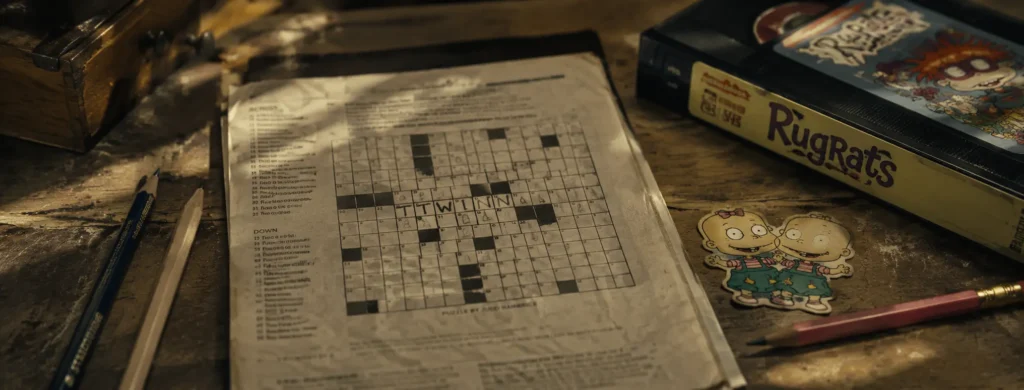
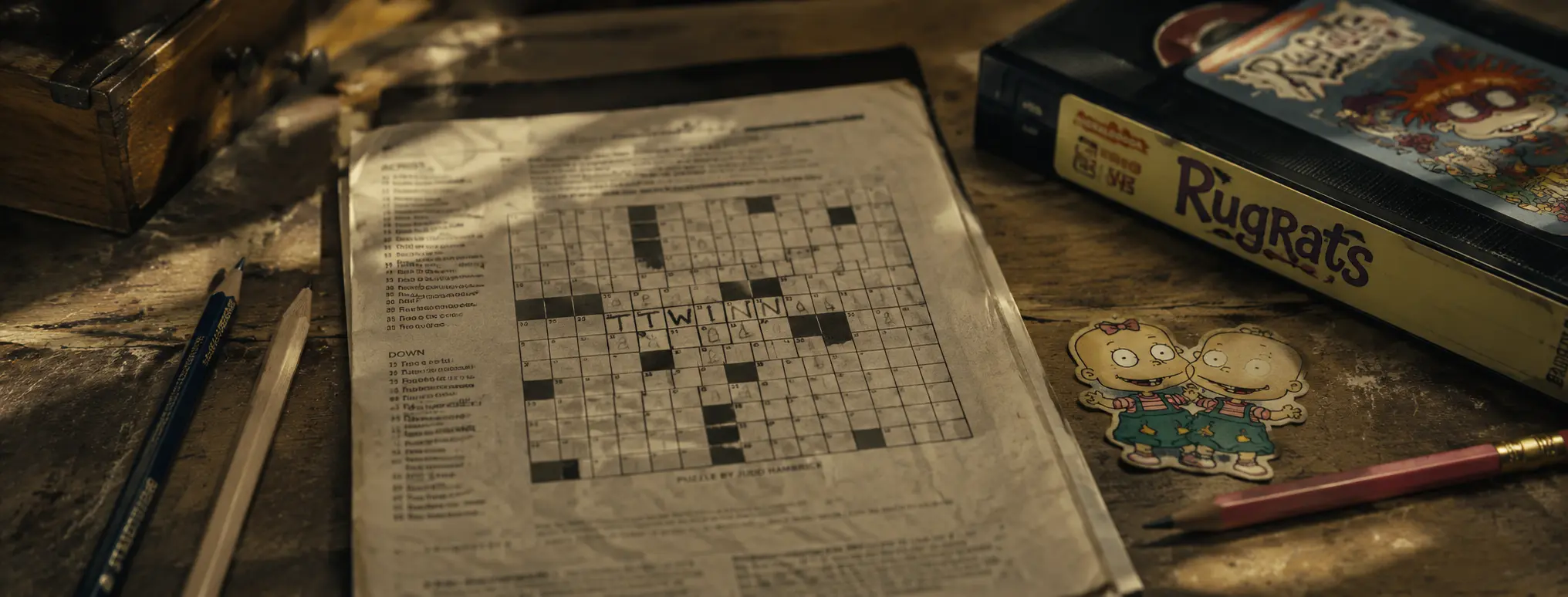
Few crossword clues blend nostalgia and logic quite like “Phil or Lil of Rugrats.” On the surface, it looks like a name lookup — but crossword constructors rarely want the obvious answer. Understanding what the clue is actually asking takes knowing the characters, knowing the puzzle, and knowing when letter count overrides instinct.
This guide covers every angle: the most common answers, why TWIN leads the pack, when DEVILLE fits better, and the full story of Phillip and Lillian DeVille — the fraternal twins whose 30-plus years in animation made them crossword staples on both sides of the Atlantic.
The Crossword Answer — Quick Reference
The most common answer to the crossword clue “Phil or Lil of Rugrats” is TWIN — four letters, referencing the shared identity of Phil and Lil DeVille as fraternal siblings in the Nickelodeon animated series Rugrats. The clue is not asking for a character name; it is asking you to categorize what both characters are.
When the clue is phrased differently, or when your grid has seven letter spaces rather than four, DEVILLE is the answer — the family surname shared by both characters. For grids with shorter constraints, the answers LIL (3 letters) or PHIL (4 letters) are also used depending on how the constructor worded the specific clue.
The phrase “Phil or Lil” is the tell. When a crossword clue gives you two examples connected by “or,” it’s almost always steering you toward a category, not a specific name. Think of it like the clue “Paris or Rome, e.g.” — the answer there would be CAPITAL, not FRANCE or ITALY. The same logic applies here.
Who Are Phil and Lil? The DeVille Twins Explained
Phillip Richard William DeVille and Lillian Marie Jill DeVille — better known as Phil and Lil — are fraternal twin toddlers and core characters in the Nickelodeon animated series Rugrats. They are the children of Howard and Betty DeVille, the neighbors of Tommy Pickles, and they appear in the vast majority of the show’s 172 original episodes.
Despite being fraternal twins — meaning they are not genetically identical — Phil and Lil were deliberately drawn in the original series to look nearly indistinguishable. Their parents, on screen, frequently confused the two. The animators used small but consistent details to tell them apart: Phil wore blue shoes and shorts with no ear lobes shown, while Lil wore pink shoes, a pink hair bow, and always had visible ear lobes. Lil is canonically two minutes older than her brother.
Both characters were voiced throughout the original series by Kath Soucie, who also voiced their mother Betty. This made Soucie one of the most distinctive contributors to the show’s audio identity, performing three related characters across hundreds of episodes. In the 2021 Paramount+ reboot of Rugrats, the twins were reimagined in CGI animation while largely retaining their original personalities and dynamic.
“
Phil and Lil are twins who are alike in every possible way, to the point that even their parents had a tendency to mistake one for the other.
— Nickelodeon Wiki, on the DeVille twins’ original character description
Personalities: Similar Beginnings, Diverging Paths
In the original Rugrats run, Phil and Lil were essentially a single comedic unit. Both shared a passion for mud, worms — which they affectionately called “chocolate spaghetti” — and messy outdoor play. They finished each other’s sentences, dressed in matching outfits, and represented the show’s recurring theme that sibling bonds can survive constant, enthusiastic conflict.
The spin-off series All Grown Up!, which premiered in 2003 and imagined the babies as preteens, deliberately pulled them apart. Lil developed her own social interests, got into sports, and started to find her twin’s grosser habits embarrassing. Phil, meanwhile, was described by the show as “socially inept” but sharp in his own way — still drawn to the strange and slimy, but with a more self-aware edge. Their biggest arguments in the spin-off became actual dramatic story arcs rather than brief baby squabbles.
Their birthday, according to a Nickelodeon magazine from the show’s original run, falls on March 31st. In the timeline of the series, they are approximately 15 months old when Tommy Pickles is 12 months, making them three months older than the show’s primary protagonist. These small canonical details — while never central to any episode — became the kind of trivia that crossword constructors and pop culture puzzle writers love to reference.
Rugrats: A Brief History of the Show
Rugrats premiered on Nickelodeon on August 11, 1991, as one of the original three Nicktoons — the network’s first batch of original animated programming, alongside Doug and The Ren & Stimpy Show. It was created by Arlene Klasky, Gábor Csupó, and Paul Germain, produced by the animation studio Klasky Csupo Inc., which Klasky and Csupó had founded in Los Angeles in 1982.
The concept was deliberately simple: follow a group of toddlers navigating everyday situations — birthday parties, trips to the zoo, visits from relatives — but told entirely from the babies’ perspective. Their internal logic, fears, and misunderstandings of adult speech formed the show’s comic and occasionally touching engine. The premise turned mundane domestic settings into surprisingly rich territory for storytelling.
After its initial run ended in 1994, the show was revived in 1997 and ran continuously until 2004 — making it, at the time, Nickelodeon’s longest-running animated series. Over its lifespan, Rugrats accumulated four Daytime Emmy Awards, six Kids’ Choice Awards, and a star on the Hollywood Walk of Fame. It was also among the first animated series aimed at children to acknowledge Jewish holidays in dedicated episodes, with Passover and Hanukkah specials that aired during the mid-1990s.
Phil and Lil appeared in most of the show’s episodes from its very first season. Their debut came in “Tommy Pickles and the Great White Thing,” which established the full core cast. They remained part of the ensemble through every major chapter of the franchise, including both theatrical films and the 2021 reboot, where they were voiced by new performers while maintaining the same essential sibling dynamic.
The longevity of the show — and the distinct visual identity of the twins, with their matching outfits and complementary color coding — made Phil and Lil one of the most recognizable sibling duos in animated television history. That recognizability is precisely why crossword constructors keep reaching for them. Even solvers who have never watched a single episode of Rugrats tend to have absorbed the name “DeVille” or the concept of the show’s twins through decades of cultural osmosis. If you enjoy puzzle content and want more entertainment trivia, check out our guide to unblocked games and interactive entertainment for more ways to keep your mind sharp.
How to Choose the Right Answer for Your Grid
The single most reliable tool you have is the letter count of the empty spaces in your grid. Before considering anything else — context, crossing clues, or puzzle theme — count the squares. That narrows things down quickly.
If You Have 4 Letters
TWIN is your first instinct, and it’s usually correct. This answer works especially well when the clue includes “e.g.” or phrasing that suggests a category rather than a specific character. The clue “Phil or Lil of Rugrats, e.g.” almost invariably points here. PHIL is also four letters, but constructors rarely use the clue phrasing “Phil or Lil” and then want PHIL as the answer — that would be a logical contradiction within the clue itself.
If You Have 7 Letters
DEVILLE is the target. Phil and Lil share the surname DeVille — inherited from their parents Howard and Betty DeVille — and seven-letter surname clues are a reliable crossword construction tool. The answer fits neatly into medium-length grid entries and has strong vowel distribution, which constructors value when building crossing sections of a puzzle.
If You Have 3 Letters
LIL works here, and it appears in quick crossword formats particularly when the clue is specifically referencing one of the twins by name. Some constructors also occasionally use SIS (sister) for three-letter entries when the crossing letters support it and the clue is worded with a family relationship angle.
“When a crossword gives you two examples linked by ‘or,’ it’s asking you to name their category — not to pick one of the examples.”
— GossipWire Editorial Desk
Using Crossing Letters to Confirm
Once you’ve identified your likely answer based on letter count, check the intersecting letters from crossing clues. If your 4-letter answer starts with T and a crossing clue gives you a T in that position, TWIN is confirmed. If it starts with P, revisit whether PHIL makes contextual sense given the specific wording of your clue. Crossing letters are the most objective confirmation available.
One final note on DEVILLE specifically: crossword appearances of this answer sometimes reference the mother Betty DeVille rather than the twins themselves. Betty is a prominent supporting character — a boisterous, assertive parent who became one of the show’s most quoted adult figures — and her surname connects to the same family unit. If your clue mentions Betty DeVille or references a Rugrats parent, the answer may still be DEVILLE but the pathway through the clue differs.
Crossword Strategy: Why Pop Culture Clues Work This Way
Pop culture crossword clues operate on a specific logic that differs from general knowledge questions. A trivia question might ask, “What is Phil DeVille’s last name?” expecting DEVILLE. A crossword clue asking “Phil or Lil of Rugrats” is asking something subtler — it wants you to identify the relationship, the category, or the shared property of both names, not to retrieve a specific isolated fact.
This distinction catches solvers off guard because pop culture references feel like name-lookup exercises. The instinct is to think: I know these characters — Phil. Done. But the “Phil or Lil” phrasing is a structural signal, not an invitation to pick one. Crossword editors use this construction deliberately to add a layer of misdirection without being unfair.
Why Rugrats Keeps Appearing in Puzzles
Several factors make Rugrats — and Phil and Lil specifically — durable crossword material. The show ran for over a decade across multiple generations of viewers, meaning its core character names are recognizable to solvers aged anywhere from their late twenties to their fifties. The 2021 Paramount+ reboot introduced the franchise to a new generation, keeping the property culturally active rather than dormant.
From a construction standpoint, the name DEVILLE has excellent utility. Seven letters, two common vowels, and no awkward consonant clusters — it slots into grids with minimal disruption. TWIN is even more versatile: four letters with a clean I in the second position, useful for almost any grid section. These practical virtues explain why constructors return to the same clue repeatedly across different publications and formats.
There’s also the matter of the clue’s slight misdirective charm. Solvers who know the show but think purely in terms of character names get tripped up — and that small friction is exactly what constructors aim for in a clue that looks easy but requires a moment of lateral thinking. It’s the crossword equivalent of a magic trick that works better on people who know a little about the subject than on those who know nothing at all.
More from GossipWire Entertainment
For daily celebrity entertainment and pop culture profiles, we recommend exploring our coverage of personalities across the UK entertainment scene. Check out our profile of Kwoklyn Wan and Oilen Wan, the siblings of TV personality Gok Wan — another sibling story with its own resonance for anyone who finds family dynamics as interesting in real life as in animation. Additionally, if you love entertainment from a lifestyle angle, covers celebrity culture with the same attention to detail this guide brings to crossword clues.
Variant Clue Phrasings to Watch For
The core clue “Phil or Lil of Rugrats” appears across NYT Mini, the LA Times crossword, and various quick crossword formats. But constructors also rephrase it in ways that shift the expected answer. Knowing these variants prevents the same subject from catching you out twice:
- “DeVille sibling” — typically a four or seven letter answer; TWIN or DEVILLE depending on grid
- “Kath Soucie role” — expert-level phrasing referencing the voice actress; answer likely LIL or PHIL for a specific character
- “One of the Rugrats” — broader clue where Tommy, Chuckie, Phil, or Lil could all theoretically fit; crossing letters essential
- “Rugrats twins’ surname” — seven letters, DEVILLE is the clear target here
- “Betty DeVille’s child” — four letters, TWIN or PHIL depending on specific grid and crossing pattern
Crossword editors at different publications also have distinct house styles. The New York Times tends toward clean categorical clues and prefers TWIN for this entry. Quick crosswords in British newspapers often favor the surname angle. If you’re solving a themed puzzle around animation or children’s television, the clue might also point toward a longer thematic answer, so always consider the puzzle’s broader construction before committing.
One crossword convention worth remembering: if the clue ends in a question mark, the constructor is flagging wordplay or a twist. “Phil or Lil of Rugrats?” with a question mark might be hinting at something more lateral — like TODDLER, SIBLING, or even a pun-based answer. No question mark typically means a straightforward categorical or definitional clue.
The pop culture knowledge that powers puzzle-solving overlaps significantly with the kind of family entertainment history that defines British and American childhood alike. For a look at another well-known family dynamic from the world of entertainment, our profile of Mischa Rodgers offers an interesting parallel in how public figures’ family members carry recognizable surnames into cultural conversations of their own.