

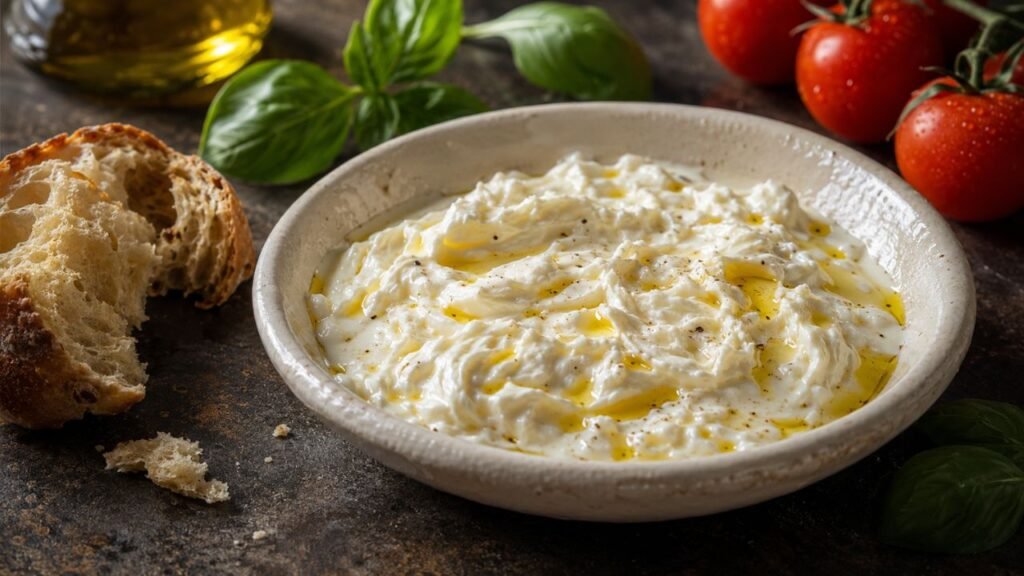
The loose, cream-soaked ribbons behind burrata are becoming a destination ingredient rather than a hidden filling.
Burrata has become a familiar restaurant staple, but its most memorable part is often the part diners never see before the knife goes in: stracciatella. That creamy centre is increasingly sold by itself—and it changes what home cooks, chefs, and buyers should expect from fresh Italian cheese.
The confusion is understandable. “Stracciatella” can mean a cheese, a Roman soup, or chocolate-flecked gelato. On a cheese counter or menu, however, it refers to a perishable mixture of stretched-curd cheese ribbons and cream.
That distinction matters right now because stracciatella is not a firmer mozzarella ball, a long-aged cheese, or simply burrata without the presentation. It is a high-moisture ingredient whose freshness, handling, and texture determine whether a dish feels luxurious or merely heavy.
Stracciatella cheese is a fresh Italian pasta filata cheese made from hand-torn mozzarella-like ribbons mixed with cream. It comes from Puglia, commonly fills burrata, and is also sold on its own. Its defining qualities are cool, creamy dairy flavour and tender strands; refrigeration and prompt use are essential.
The Puglian Craft Hidden Inside Burrata
Stracciatella belongs to the dairy tradition of Puglia in southern Italy, the region closely associated with burrata. Its name comes from stracciare, meaning “to tear” or “to shred,” a direct reference to the irregular ribbons of stretched cheese suspended in cream.
Burrata and stracciatella are related but not interchangeable. Burrata is a pouch of stretched curd filled with stracciatella; stracciatella is the filling itself, served loose. The European Commission’s product specification for Burrata di Andria PGI describes that filling as hand-shredded pasta filata mixed with cream.
The historical story is best treated carefully. Oral tradition connects burrata in Andria with cheesemaker Lorenzo Bianchino in the early twentieth century, but the precise origin story is less important than the practical idea behind it: using torn stretched curd with cream to create a fresh, rich product rather than wasting valuable dairy material.
Six facts that define real stracciatella
- Category: Fresh, soft, high-moisture Italian cheese.
- Core texture: Irregular strands of stretched curd in cream.
- Regional anchor: Puglia, especially through its association with burrata.
- Milk source: Usually cow’s milk; buffalo-milk versions also exist.
- Relationship to burrata: It is typically burrata’s creamy filling.
- Best use: Spooned cold or cool onto finished dishes rather than aggressively cooked.
- Shelf life: Short and product-specific; the package date and storage instructions control.
- Common confusion: It is not stracciatella gelato and not Roman stracciatella soup.
Cream, Stretched Curd, and the Moment Its Texture Is Made
Stracciatella begins with the same broad pasta filata logic used for mozzarella. Milk is coagulated into curd, the curd is acidified or matured to become stretchable, and heat transforms it into an elastic mass that can be pulled and shaped.
The decisive step comes after stretching. Instead of forming all of the curd into neat balls, producers tear part of it into uneven ribbons. Those strands should remain distinct enough to give the cheese a delicate pull and slight bounce rather than turning into a uniform paste.
Cream is then folded through the ribbons, usually with salt and, depending on the producer, additional milk-derived ingredients or stabilisers. The result should feel loose and spoonable, with cream clinging to the strands rather than drowning them.
For Burrata di Andria PGI, hand-shredding is specifically valued because irregular ribbons absorb cream differently from mechanically minced cheese. That does not mean every commercial tub must be handmade to be enjoyable; it means texture is the central quality test.
The Buyer’s Grid: Stracciatella, Burrata, Mozzarella, and Gelato
| Item | How it is made | What it feels like | Best use |
|---|---|---|---|
| Stracciatella cheese | Torn stretched-curd ribbons mixed with cream | Loose, creamy, tender, lightly elastic | Bread, salads, pasta, vegetables, pizza finishing |
| Burrata | A stretched-curd pouch filled with stracciatella | Firm outer skin with a flowing centre | Whole presentation, sharing plates, composed starters |
| Fresh mozzarella | Stretched curd shaped into balls or logs | Springy, moist, mild, less cream-rich | Melting, caprese, sandwiches, pizza |
| Stracciatella gelato | Sweet frozen cream with chocolate shards | Frozen, sweet, chocolate-flecked | Dessert only |
If a recipe calls for burrata, stracciatella can deliver its creamy centre but cannot replicate the visual moment of cutting through the outer shell. If a recipe calls for stracciatella, using whole burrata may add unnecessary moisture and make portioning harder.
Editorial test: If a dish needs warm, elastic cheese pull, use mozzarella. If it needs a cold, spoonable, cream-rich finish, use stracciatella. Treating them as interchangeable is how a clean dish becomes watery or heavy.
From the Chilled Counter to the First Spoonful
Freshness is not a marketing detail with stracciatella; it is the product. Buy it from a properly refrigerated display, inspect the use-by date, and keep it cold from shop to refrigerator. A visibly swollen package, broken seal, sour smell, or unusual discolouration is a reason to discard it.
The most useful label details are straightforward:
- Milk type: cow’s milk or buffalo milk.
- Whether the milk and cream are pasteurised.
- Ingredient list, including any thickeners or stabilisers.
- Use-by date and storage temperature.
- Country or region of production, if provenance matters to the buyer.
Burrata di Andria PGI is required to be stored at approximately 4°C, reflecting the fragile nature of this style of fresh dairy. Exact storage and use-after-opening guidance varies by brand, so the package instructions should always take priority.
The FDA’s consumer guidance for soft fresh cheeses is not specific to stracciatella, but its core advice applies well to any highly perishable fresh cheese: maintain refrigeration, avoid damaged packaging, and handle it conservatively. People who are pregnant, older, immunocompromised, or otherwise at higher risk of foodborne illness should choose clearly labelled pasteurised products and follow medical advice where relevant.
The Dishes That Let the Cheese Do Its Job
Stracciatella is strongest when it arrives near the end of cooking. High heat can make the cream separate and can erase the contrast between cool richness and hot food.
For pasta, spoon it onto the finished plate rather than boiling it into the sauce. The heat from the pasta softens the cheese slightly while preserving its strands. Orecchiette with bitter greens, roasted tomatoes, grilled aubergine, lemony peas, and chilli all benefit from that contrast.
For pizza, add stracciatella after baking or in the final moments, especially on a crisp base with tomatoes, roasted squash, mushrooms, anchovies, or spicy salami. The goal is not a thick white blanket; it is small, creamy pockets that balance acidity, salt, and char.
It also works with almost no cooking at all:
- Grilled sourdough, olive oil, flaky salt, and cracked black pepper.
- Peak-season tomatoes, basil, and aged balsamic vinegar.
- Roasted peppers, capers, and oregano.
- Warm lentils or beans with herbs and lemon.
- Stone fruit, pistachios, and a restrained drizzle of honey.
- Charred broccoli or broccolini with chilli and toasted breadcrumbs.
The cheese needs contrast. Acid, bitterness, herbs, chilli, toasted crumbs, and crisp bread stop its dairy richness from becoming flat.
The Questions Behind the Cheese Counter
Is stracciatella cheese the same thing as burrata?
Stracciatella cheese is the creamy filling commonly found inside burrata, while burrata is the complete pouch-shaped cheese. Burrata has an outer shell of stretched curd surrounding stracciatella. A tub of stracciatella gives you the centre directly, without burrata’s enclosing mozzarella layer.
What is stracciatella cheese made from?
Stracciatella cheese is made from shredded or hand-torn stretched curd, similar to fresh mozzarella, mixed with cream. Depending on the producer, it may use cow’s milk or buffalo milk and include salt, cultures, rennet, or ingredients that help maintain texture. The cream-and-ribbon structure is its defining feature.
Does stracciatella cheese taste like mozzarella?
Stracciatella cheese tastes related to mozzarella because both use stretched curd, but it is richer, softer, and more cream-forward. Good stracciatella has a clean milky flavour, light salinity, and tender strands. Mozzarella is generally firmer, less creamy, and better suited to melting or slicing.
Is stracciatella cheese the same as stracciatella gelato?
Stracciatella cheese is not the same as stracciatella gelato. The cheese is a savoury fresh dairy product from Puglia made with curd ribbons and cream. Stracciatella gelato is a sweet frozen dessert, usually vanilla-like cream gelato with thin chocolate shards. They share a name, not a recipe.
Can stracciatella cheese go on pizza or pasta?
Stracciatella cheese is excellent on pizza and pasta when added after most cooking is complete. On pizza, spoon it over the baked crust or add it just before serving. On pasta, place it on top of the finished dish so the residual heat softens it without breaking down its cream and strands.
How should stracciatella cheese be stored?
Stracciatella cheese should be kept refrigerated according to the package instructions, ideally at or below 4°C. Use the product by its stated date and consume opened cheese promptly rather than relying on a universal number of days. Because it is a moist fresh dairy product, do not leave it unrefrigerated for extended periods.
The Ingredient That Makes Burrata Make Sense
Stracciatella is not merely burrata without the photo-friendly exterior. It is a separate fresh-cheese experience: more direct, more spoonable, and often more useful in cooking because the cook controls every portion.
The best way to understand it is simple. Buy it very fresh, keep it cold, pair it with ingredients that offer contrast, and let it remain recognisably itself—cream wrapped around torn ribbons of stretched curd.
Sources & Verification
- European Commission, Burrata di Andria PGI product specification and Official Journal documentation.
- U.S. Food and Drug Administration, Queso Fresco-type Cheeses Consumer Guidance.
- Product-specific storage, milk source, and ingredient information should always be verified against the current manufacturer label.