

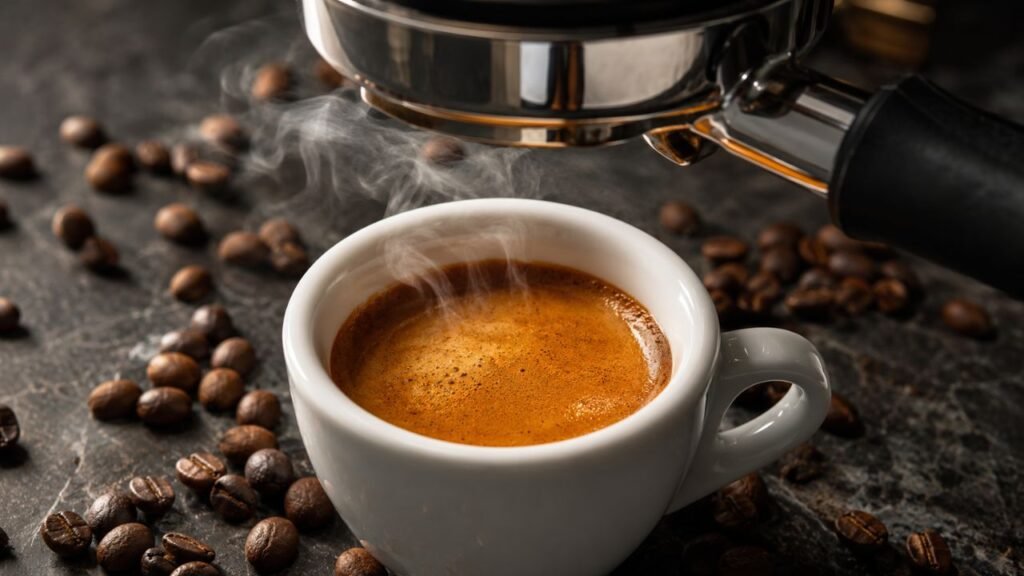
The smallest drink on the coffee menu is also one of the most technically demanding—and most frequently misunderstood.
Espresso powers cappuccinos, flat whites, Americanos and countless iced drinks. Yet many people still assume it is a particular coffee bean, an extra-dark roast or simply a stronger version of ordinary black coffee.
That confusion now extends to capsule brewers, stovetop moka pots and home machines advertised with 15 or 19 bars of pressure. All can produce concentrated coffee, but they do not necessarily reproduce the extraction method that defines traditional café espresso.
The distinction matters. It affects which beans and equipment you buy, how you judge a shot and how much caffeine you may actually consume.
Bottom line: Espresso is a concentrated coffee beverage made by forcing hot water, usually near 90–96°C, through a compact bed of finely ground coffee under roughly 9 bars of pressure. A typical modern double uses 18–20 grams of coffee and yields about 36–40 grams in 25–30 seconds.
Espresso at a Glance
- Definition: A pressure-brewed, concentrated coffee beverage
- Origin: Italy, evolving from late-19th-century steam machines
- Traditional serving: Approximately 25–35 millilitres for a single shot
- Modern specialty recipe: Often 18–20 grams of coffee producing 36–40 grams of espresso
- Typical brewing pressure: Around 9 bars at the coffee bed
- Signature feature: A concentrated liquid topped by crema
- Bean requirement: None—Arabica, Robusta, blends and decaffeinated coffee can all be used
- Correct spelling: Espresso; “expresso” is a recognised variant in some English dictionaries but is not the Italian spelling
The Essential Correction: Espresso Is a Method, Not a Bean
There is no botanical variety called an espresso bean. All espresso begins with roasted coffee seeds, usually from Coffea arabica, Coffea canephora—commonly called Robusta—or a blend of the two.
“Espresso roast” is also not a regulated roast category. It usually means the roaster believes that profile will perform well under espresso’s concentrated brewing conditions. One roaster may use a dark, chocolate-led profile; another may offer a light-roasted, fruit-forward single origin.
What makes the drink espresso is the interaction of four conditions:
- Finely ground coffee forms a resistant bed known as the puck.
- Hot water enters that puck under substantial pressure.
- Extraction happens rapidly, generally within half a minute.
- The resulting beverage contains a high concentration of dissolved compounds, suspended particles and emulsified oils.
Filter coffee depends mainly on gravity. A French press uses immersion. A moka pot relies on modest steam pressure. Espresso uses substantially greater controlled pressure to move water through a compact coffee bed.
That combination creates the drink’s dense body and concentrated aroma. Espresso commonly measures around 8–12% total dissolved solids, while filter coffee is often closer to 1–1.5%. These figures describe concentration, not quality: a strong espresso can still be poorly extracted.
What Pressure Does During Those Crucial 30 Seconds
The traditional definition and current café practice are not identical. The heritage definition reported by the Specialty Coffee Association describes a 25–35-millilitre beverage made from 7–9 grams of coffee at 9–10 atmospheres in 20–30 seconds.
A 2017 SCA survey, heavily weighted toward US specialty cafés, found a different working norm: an 18–20-gram dose, approximately 36.5 grams of beverage, a 1:2 brew ratio, 25–30 seconds and pressure near 9 bars. Neither recipe is a universal law.
| Brewing variable | Heritage reference | Common modern starting point | Why it matters |
|---|---|---|---|
| Dry coffee dose | 7–9 g for a single | 18–20 g for a double | Sets the available coffee mass and appropriate basket size |
| Beverage yield | 25–35 ml for a single | 36–40 g from 18–20 g | Controls concentration and the amount extracted |
| Brew ratio | Traditionally measured by volume | Approximately 1:2 by weight | Makes recipes repeatable across coffees and machines |
| Water temperature | 90.5–96.1°C | Approximately 92–94°C | Changes extraction rate and flavour expression |
| Pressure | 9–10 atmospheres | Approximately 9 bars | Drives water through the compact puck |
| Contact time | 20–30 seconds | Commonly 25–30 seconds | Provides a diagnostic window rather than a quality guarantee |
| Grind | Fine | Adjusted for target flow and taste | Controls resistance, flow and extraction uniformity |
Dose, Yield and Ratio
The dose is the mass of dry coffee in the basket. Yield is the mass of espresso in the cup. Their relationship is the brew ratio.
An 18-gram dose producing 36 grams of espresso has a 1:2 ratio. A shorter 27-gram yield gives a 1:1.5 ratio; a longer 54-gram yield gives 1:3.
Weighing the beverage is more reliable than judging volume because crema contains gas. Two visually identical shots can contain different amounts of liquid.
Grind Size Controls the Flow—but Finer Is Not Always Better
A finer grind generally creates greater resistance and slows the shot. A coarser grind usually allows faster flow. That simple rule has limits.
If the coffee is excessively fine or poorly distributed, water may find narrow paths through the puck. This is channeling: some grounds receive too much water while others remain insufficiently extracted. The cup can taste simultaneously sharp, bitter and hollow.
Peer-reviewed modelling and experiments have shown that very fine grinding can produce uneven flow and reduce reproducibility. A uniform puck is therefore more valuable than maximum resistance.
Tamping Creates Consistency, Not Pressure
Tamping compresses and levels the grounds before brewing. Its purpose is to produce an even coffee bed without cracks or weak areas.
Once the grounds are fully compressed, tamping harder offers little advantage. Consistent distribution, an appropriate basket dose and a level tamp matter more than achieving a particular number of kilograms or pounds of force.
Crema Is Chemistry, Not a Quality Certificate
Roasting creates carbon dioxide inside coffee beans. During espresso extraction, pressure helps dissolve that gas in the liquid. When the espresso exits the basket and returns to atmospheric pressure, carbon dioxide forms tiny bubbles. Coffee compounds help stabilise those bubbles into crema.
Crema can reveal something about freshness, bean composition and pressure-based extraction. It cannot prove that the espresso tastes good. Robusta-rich blends often produce abundant crema, while carefully brewed light-roast Arabica may produce less.
A thick crema can cover a bitter, poorly balanced shot. Taste remains the decisive test.
A Dependable Recipe for Starting at Home
For a conventional double espresso:
- Place an 18-gram basket in a fully heated machine.
- Grind 18 grams of coffee immediately before brewing.
- Distribute the grounds evenly and tamp level.
- Aim for 36 grams of espresso in approximately 25–30 seconds.
- Keep the dose constant while adjusting the grinder.
- If the shot runs too quickly and tastes thin or sharply sour, grind finer.
- If it runs very slowly and tastes harsh or drying, grind coarser or reduce the yield.
- Once the flow is stable, adjust the final yield according to taste.
Machines promoted as producing 15 or 19 bars usually advertise maximum pump capability. That does not mean coffee should be extracted at that pressure. Conventional espresso remains centred near 9 bars at the brew group, although pressure profiling can deliberately vary it during the shot.
From Turin Boilers to the Nine-Bar Café Standard
Espresso was not invented in a single finished form. It developed through successive attempts to prepare coffee faster, one customer at a time.
- 1884 — Angelo Moriondo: The Turin inventor patented an early machine that used separate supplies of hot water and steam. It was primarily a bulk-brewing system rather than a modern single-shot espresso machine.
- 1901–1903 — Luigi Bezzera: Bezzera developed machinery for quickly preparing individual servings. His US Patent No. 726,793, filed in 1902 and granted in 1903, described a detachable coffee-preparing apparatus connected to a heated boiler. The patent was assigned to Desiderio Pavoni.
- 1906 — Milan International Fair: Bezzera and Pavoni presented their commercial system to a wider audience. These early machines relied on steam pressure, brewed extremely hot and produced a drink unlike the crema-topped espresso served today.
- 1947–1948 — Achille Gaggia: Gaggia’s spring-lever mechanism pushed hot water through coffee at much higher pressure without relying on boiler steam alone. The resulting foam was initially promoted as crema caffè.
- 1961 — Faema E61: The E61 used a motor-driven volumetric pump to maintain pressure near 9 atmospheres. Its pre-infusion and thermosyphon-based temperature system helped establish the architecture associated with modern commercial machines.
- Modern era: Electronic temperature control, gravimetric scales, pressure profiling, flow control and precision grinders have expanded the range of viable espresso styles. The essential mechanism—pressurised water moving through finely ground coffee—remains intact.
The word itself comes from Italian caffè espresso. Its historical meaning is associated both with coffee prepared expressly for the customer and with the idea of something pressed or expressed. Speed was central, but espresso was never simply “fast coffee.”
Italy Wrote the Grammar; Coffee Origins Changed the Accent
In an Italian bar, ordering un caffè normally means espresso. The traditional drink is small, prepared quickly and often consumed while standing at the counter. Darker roasts and blends containing some Robusta have historically suited the desired body, bitterness, crema and reliability.
Specialty cafés in the United States, United Kingdom, Australia and elsewhere often use larger double baskets, lighter roasts and weight-based recipes. These shots may emphasise acidity, fruit, florals or origin character rather than heavy roast flavours.
Neither approach has exclusive ownership of quality. They pursue different sensory goals.
Arabica, Robusta and Blends
Arabica is often selected for aromatic complexity, sweetness and acidity. Robusta commonly contributes heavier body, greater bitterness, more crema and higher caffeine concentration. Those are broad species tendencies; origin, variety, farming, processing and roasting can produce major exceptions.
Blends allow roasters to combine attributes. A Brazilian component may provide chocolate and body, an East African coffee may add fruit or floral notes, and Robusta may strengthen structure and crema. Single-origin espresso instead places greater emphasis on the character of one producer, region or harvest.
Roast Level Changes How the Recipe Behaves
Darker coffee is more porous and generally extracts more readily. It often works with slightly cooler water or a shorter ratio to control bitterness.
Lighter coffee is denser and less soluble. It may benefit from hotter water, longer yields, careful pre-infusion or a grinder capable of producing a narrow particle distribution. Pulling a light roast with a traditional short, cool recipe can produce aggressive acidity and insufficient sweetness.
Freshness also matters. Coffee releases carbon dioxide after roasting. Extremely fresh beans can contain enough gas to make extraction unstable, while old coffee may have weak aroma and rapidly disappearing crema. The useful window depends on the coffee, roast, packaging and storage rather than one universal number of days.
One Shot, Many Drinks—and One Persistent Caffeine Myth
Espresso is both a finished beverage and an ingredient. The names below describe useful conventions, but café recipes vary by country, cup size and house style.
| Drink | What defines it |
|---|---|
| Espresso | A standard pressure-extracted shot |
| Doppio | A double espresso |
| Ristretto | A shorter espresso, commonly near a 1:1 to 1:1.5 brew ratio |
| Lungo | A longer extraction, often near 1:3 or beyond |
| Americano | Espresso diluted with hot water |
| Long black | Hot water followed by espresso, usually preserving more crema |
| Macchiato | Espresso “marked” with a small amount of milk or foam |
| Cortado | Espresso combined with roughly comparable warm milk and little foam |
| Cappuccino | Espresso with steamed milk and a defined layer of foam |
| Flat white | Espresso with a relatively small amount of finely textured microfoam |
| Caffè latte | Espresso with a larger proportion of steamed milk |
Adding water changes concentration but does not remove caffeine already extracted. An Americano made with two shots contains approximately the caffeine of those two shots, regardless of how much water is added.
More Caffeine per Ounce Does Not Always Mean More per Drink
Espresso contains more caffeine per unit of volume than filter coffee. Its serving size, however, is much smaller.
USDA legacy reference data lists approximately 63 milligrams of caffeine in one fluid ounce of restaurant-prepared espresso and approximately 95 milligrams in eight fluid ounces of brewed coffee. These are reference values, not reliable predictions for every café. Bean species, dose, recipe and number of shots can change the result substantially.
The US Food and Drug Administration cites 400 milligrams per day as an amount not generally associated with negative effects for most adults. It also stresses that sensitivity and caffeine metabolism vary considerably. The FDA’s caffeine guidance should not be interpreted as an individual target or guarantee of tolerance.
Questions People Ask Before Their Next Shot
Is espresso stronger than regular coffee?
Espresso is stronger in concentration, flavour intensity and caffeine per fluid ounce. A complete serving does not automatically contain more caffeine because espresso is consumed in much smaller quantities. A double espresso may exceed some cups of brewed coffee, while a single shot will often contain less than a large filter coffee.
Is espresso a particular type of coffee bean?
Espresso is a brewing method, not a coffee species, variety or mandatory roast level. Arabica, Robusta, blends, single-origin coffees and decaffeinated beans can all produce espresso. Labels such as “espresso beans” usually communicate the roaster’s intended brewing use rather than a separate agricultural category.
How much caffeine is in one espresso shot?
One espresso shot is often estimated at approximately 60–65 milligrams of caffeine, based on USDA legacy reference data for a one-ounce serving. Actual amounts can differ considerably. Coffee species, dry dose, extraction yield and café recipe all matter, while a modern double may contain substantially more than a traditional single.
Why does espresso have crema?
Crema is the foam created when carbon dioxide, oils and other coffee compounds emerge from a pressurised extraction. As the liquid returns to atmospheric pressure, dissolved gas forms small bubbles on the surface. Crema is characteristic of espresso, but its colour or thickness alone cannot determine whether a shot is balanced.
Can you make real espresso without an espresso machine?
Espresso is difficult to reproduce without equipment capable of generating controlled pressure through a compact coffee puck. Manual lever devices can make genuine espresso without electricity. Moka pots, AeroPress brewers and concentrated pour-overs can produce strong coffee, but they do not normally match the pressure, texture or extraction mechanics of café espresso.
What is the difference between espresso and black coffee?
Espresso is a specific high-pressure brewing method that produces a small, concentrated beverage. Black coffee simply means coffee served without milk or creamer; it can be prepared by filter, immersion, percolation, espresso or another method. Espresso is therefore black coffee when served plain, but not all black coffee is espresso.
The Small Cup Makes Technique Visible
Espresso compresses an entire brewing process into a few tablespoons of liquid. There is little water or milk to conceal stale beans, uneven grinding, channeling or an unsuitable recipe.
That sensitivity is precisely what makes espresso compelling. It is not defined by darkness, bitterness, crema thickness or expensive machinery. It is defined by controlled pressure extraction—and judged, ultimately, by whether sweetness, acidity, bitterness, aroma and texture form a coherent cup.
Sources & Verification
- Specialty Coffee Association, “Defining the Ever-Changing Espresso,” 2018; heritage definition and 2017 Barista Guild survey.
- Cameron, M. I. et al., “Systematically Improving Espresso: Insights from Mathematical Modeling and Experiment,” Matter, 2020, DOI: 10.1016/j.matt.2019.12.019.
- Illy, E. and Navarini, L., “Neglected Food Bubbles: The Espresso Coffee Foam,” Food Biophysics, 2011, PMCID: PMC3140933.
- US Department of Agriculture, FoodData Central, SR Legacy entries 171891 and 171890; espresso and brewed-coffee composition data.
- US Food and Drug Administration, “Spilling the Beans: How Much Caffeine Is Too Much?” updated 2024.
- US Patent No. 726,793, Luigi Bezzera, “Coffee-Making Machine,” granted April 28, 1903.
- Gaggia and Faema manufacturer archives; lever-piston and E61 technical histories.
- Smithsonian Magazine, “The Long History of the Espresso Machine,” 2012; historical context cross-checked against patent records.
Editorial Disclaimer: This article provides general culinary and educational information. Espresso recipes, caffeine levels, cup volumes and sensory results vary by coffee, equipment and operator. Approximate ranges are identified as reference points rather than universal specifications or medical guidance.