

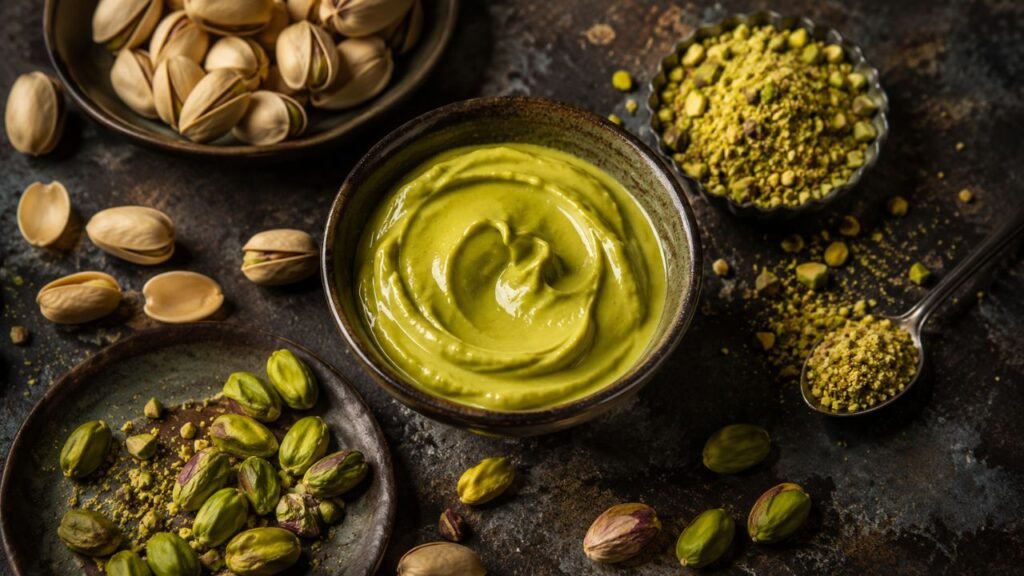
The green kernel in your dessert, snack bowl, or recipe is not two different ingredients; the real distinction is usually language, processing, and what else the package contains.
“Pista” and “pistachio” often appear side by side in recipes, sweet-shop menus, grocery listings, and wellness claims. That can make shoppers wonder whether pista is a cheaper substitute, a different nut, or simply another name.
The answer matters beyond vocabulary. A jar of pista paste, a bag of salted pistachios, and pistachio-flavoured ice cream can have very different ingredient lists, nutrition profiles, and allergen implications—even when all use the same familiar green nut.
The name is also culturally meaningful. “Pista” is widely used across South Asian, Persian-influenced, and Middle Eastern food traditions, while “pistachio” is the standard English name used on many international labels.
Pista and pistachio are the same edible seed in food and recipe contexts: the kernel of Pistacia vera. “Pista” is a common South Asian and Persian-influenced name; “pistachio” is the standard English term. Package differences usually reflect language, processing, salt, sugar, or added flavour—not a different nut.
The Answer That Settles the Grocery-Aisle Debate
Pista is pistachio.
The word pista commonly refers to the pistachio nut, especially in Urdu, Hindi, Persian-influenced food language, and South Asian cooking. You may see it in names such as pista kulfi, pista barfi, pista milk, pista cookies, or pista ice cream.
Pistachio is the English-language name for the same ingredient. The commercially grown species is Pistacia vera, a member of the cashew family, Anacardiaceae.
In culinary language, pistachio is called a tree nut. Botanically, however, the pistachio fruit is a drupe, and the edible green portion people eat is its seed.
Quick profile: what “pista” actually means
- Common food name: Pista
- English name: Pistachio
- Botanical species: Pistacia vera
- Plant family: Anacardiaceae, the cashew family
- Edible portion: Green seed or kernel
- Typical colour: Pale green to deep green, with purple-toned skin
- Common forms: Whole kernels, shelled nuts, roasted nuts, paste, powder, oil, and dessert flavouring
- Food-allergen category in the United States: Tree nut
A Persian Word, an English Label, and One Botanical Species
The pistachio tree is native to Western Asia and Asia Minor, with a long culinary association with countries including Iran, Afghanistan, Iraq, Syria, Türkiye, and surrounding regions. It later became a major commercial crop in California and other dry, warm growing regions.
Pistachio cultivation has a specific biological requirement: male and female flowers grow on separate trees. Wind carries pollen from male trees to female trees, which produce the crop. That is one reason commercial pistachio farming depends heavily on orchard design, weather during bloom, and precise cultivar selection.
The familiar split shell is part of pistachio’s appeal. As the kernel matures, many shells naturally open, creating the recognisable crack that makes pistachios easy to identify on a shelf.
Pista is not an alternative to pistachio. It is a culturally rooted name for the same ingredient—and the smarter question is whether you are buying whole nuts, pure paste, sweetened filling, or artificial flavouring.
Why Pista Appears Everywhere From Baklava to Kulfi
Pistachio’s flavour is mild, buttery, earthy, and slightly sweet. Its green colour also gives desserts a visual signal of richness, although naturally green pistachio products are often less neon than artificially coloured versions.
In Middle Eastern and Mediterranean cooking, pistachios are used in baklava, ma’amoul, halva, rice dishes, meat fillings, and savoury sauces. In South Asian cuisine, pista is common in kulfi, kheer, falooda, mithai, milk drinks, and garnish mixtures with almonds and cardamom.
The ingredient changes character depending on how it is processed:
| Product form | What it is | Best use |
|---|---|---|
| Whole pistachios | Shelled or in-shell kernels | Snacking, salads, grazing boards |
| Ground pista | Finely crushed kernels | Baking, garnish, dessert toppings |
| Pistachio paste | Blended kernels, sometimes with sugar or oil | Gelato, pastries, fillings |
| Pistachio butter | Spreadable nut paste | Toast, smoothies, sauces |
| Pistachio oil | Pressed oil with a delicate nutty aroma | Finishing salads and vegetables |
| Pistachio flavouring | May contain limited or no real pistachio | Ice cream, confectionery, drinks |
A product called “pista” is not automatically made from 100% pistachio. The ingredient list decides that. A pure pistachio paste should list pistachios prominently, while a sweetened dessert filling may contain sugar, oils, milk solids, almonds, food colouring, or flavouring.
What One Ounce of Pistachios Actually Delivers
Pistachios are energy-dense, like other nuts, but they also provide protein, fibre, unsaturated fats, potassium, vitamin B6, copper, and manganese. The figures below are approximate for 1 ounce, or roughly 28 grams, of raw unsalted pistachio kernels, based on USDA FoodData Central.
| Nutrient | Approximate amount per 1 oz / 28 g | Why it matters in food terms |
|---|---|---|
| Calories | 159 kcal | A compact, energy-dense snack |
| Protein | 5.7 g | Adds plant-based protein to meals |
| Total fat | 12.8 g | Mostly unsaturated fat |
| Carbohydrate | 7.7 g | Includes naturally occurring sugars and fibre |
| Dietary fibre | 2.9 g | Supports overall dietary fibre intake |
| Potassium | 290 mg | A naturally occurring mineral in the nut |
The practical comparison is not “pistachios are healthy” versus “pistachios are unhealthy.” It is portion, preparation, and what accompanies them. Plain or dry-roasted unsalted pistachios are nutritionally different from pistachio brittle, syrup-heavy baklava, sugar-loaded ice cream, or heavily salted snack mixes.
The Shell, the Salt, and the Ingredient List Change the Story
The word pista can make a product sound simple and traditional, but labels should still be read closely.
Check for:
- Salt: Roasted salted pistachios can contain substantially more sodium than raw or unsalted versions.
- Added sugar: Pista sweets, spreads, fillings, and ice creams may be sugar-forward products.
- Other nuts: Pistachio blends can contain almonds, cashews, peanuts, or mixed nuts.
- Food colouring: Bright green colour does not prove a high pistachio content.
- Allergen warnings: Cross-contact statements matter for people with allergies.
Pistachio is treated as a tree nut for U.S. food-allergen labelling. The FDA’s food-allergen guidance explains that specific tree nuts must be identified when required under U.S. labelling rules.
The Most Useful Way to Buy Pista
For snacking, choose unsalted or lightly salted whole pistachios. For cooking, buy raw kernels or roasted unsalted kernels depending on the recipe. For pastries, inspect pistachio paste carefully: higher pistachio content usually creates a more natural flavour and colour, but recipes vary widely.
If a recipe says “pista,” use pistachios unless it specifically requests a prepared product such as pista powder, pista paste, pistachio butter, or pistachio essence.
Questions People Ask Before Buying Pista
Is pista different from pistachio?
Pista is pistachio in food and recipe contexts. “Pista” is commonly used in South Asian and Persian-influenced languages, while “pistachio” is the standard English name. Both refer to the edible kernel from the Pistacia vera tree.
Is pista a nut or a seed?
Pista is commonly called a tree nut, but the edible green kernel is botanically a seed. The pistachio develops inside a drupe-like fruit with a hard shell. Culinary and food-labelling language generally classifies pistachio as a tree nut.
Is pista good for everyday snacking?
Pistachios can fit into an everyday diet when portioned appropriately. They provide protein, fibre, unsaturated fat, and minerals, but they are calorie-dense. Unsalted or lightly salted pistachios are usually the more practical choice for frequent snacking.
Can someone with a peanut allergy eat pistachios?
A peanut allergy does not automatically mean a pistachio allergy, because peanuts are legumes and pistachios are tree nuts. However, people with diagnosed peanut or tree-nut allergies should seek advice from their clinician or allergist before eating pistachios, especially where cross-contact is possible.
Is pistachio ice cream made from real pista?
Pistachio ice cream may contain real pistachios, pistachio paste, pistachio flavouring, food colouring, or a combination of these. The ingredient list is the only reliable way to assess how much real pistachio is present in a specific product.
Are pistachios naturally salty?
Pistachios are naturally low in sodium. Salt is added during roasting, seasoning, or processing. Raw and unsalted pistachios are the clearest option for people who want to control their sodium intake.
One Nut, Many Names, Better Label Reading
Pista and pistachio are not competing ingredients. They are one ingredient with different linguistic routes into the kitchen.
That clarity makes shopping easier: look beyond the name, check the ingredient list, understand the preparation, and choose the form that matches the recipe. Whether it appears in a bowl of roasted nuts, a spoonful of paste, or a fragrant pista kulfi, the green kernel remains pistachio.
Sources & Verification
- U.S. Department of Agriculture, FoodData Central: “Nuts, pistachio nuts, raw.”
- U.S. Food and Drug Administration: food-allergen labelling guidance for tree nuts.
- University of California Agriculture and Natural Resources: The Pistachio Tree: Botany and Physiology and Factors That Affect Yield.
- Platts Urdu-Hindi-English Dictionary and Rekhta Dictionary: lexical references for pista / پستہ.